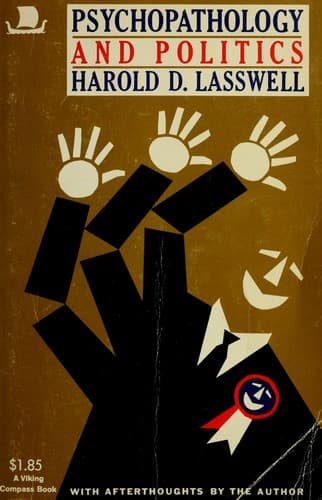
Psychopathology and politicsLasswell, Harold D. (Harold Dwight)
Science
Psychopathology and politics
Lasswell, Harold D. (Harold Dwight)
Personality and politics; Political science; Psychoanalysis; Psychology, Pathological
The premise of democracy is that each man is the best judge of his own
interest, and that all whose interests are affected should be consulted
in the determination of policy. Thus the procedure of a democratic
society is to clear the way to the presentation of various demands by
interested parties, leaving the coast clear for bargain and compromise,
or for creative invention and integration.
The findings of personality research show that the individual is a
poor judge of his own interest. The individual who chooses a political
policy as a symbol of his wants is usually trying to relieve his own
disorders by irrelevant palliatives. An examination of the total state
of the person will frequently show that his theory of his own interests
is far removed from the course of procedure which will give him a happy
and well-adjusted life. Human behavior toward remote social objects,
familiarity with which is beyond the personal experience of but a few,
is especially likely to be a symptomatic rather than a healthy and
reflective adjustment.
In a sense politics proceeds by the creation of fictitious values. The
person who is solicited to testify to his own interest is stimulated
by the problem put to him to commit himself. The terms in which he
couches his own interest vary according to a multitude of factors, but
whatever the conditioning influences may be, the resulting theory of
his interest becomes invested with his own narcissism. The political
symbol is presumably an instrumental makeshift toward the advancement
of the other values of the personality; but it very quickly ceases to
be an instrumental value, and becomes a terminal value, no longer the
servant but the coequal, or indeed the master. Thus the human animal
distinguishes himself by his infinite capacity for making ends of his
means.
It should not be hastily assumed that because a particular set of
controversies passes out of the public mind that the implied problems
were solved in any fundamental sense. Quite often the solution is a
magical solution which changes nothing in the conditions affecting the
tension level of the community, and which merely permits the community
to distract its attention to another set of equally irrelevant symbols.
The number of statutes which pass the legislature, or the number of
decrees which are handed down by the executive, but which change
nothing in the permanent practices of society, is a rough index of the
rôle of magic in politics.
In some measure, of course, discontent is relieved in the very process
of agitating, discussing, and legislating about social changes which in
the end are not substantially affected. Political symbolization has its
catharsis function, and consumes the energies which are released by the
maladaptations of individuals to one another.
Public-domain text, read in full here on John Shaqi.
Reviews
Reviews
No reviews yet
Be the first to share your thoughts on this work.
Elsewhere in the archive
Join the Discussion
Join the discussion
Sign in to leave a comment or review.
Sign InorCreate an account