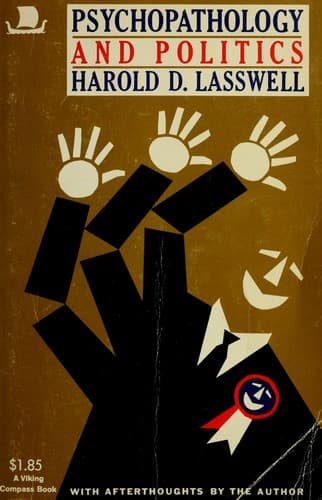
Psychopathology and politicsLasswell, Harold D. (Harold Dwight)
Science
Psychopathology and politics
Lasswell, Harold D. (Harold Dwight)
Personality and politics; Political science; Psychoanalysis; Psychology, Pathological
But discussion often leads to modifications in social practice which
complicate social problems. About all that can be said for various
punitive measures resorted to by the community is that they have
presently broken down and ceased to continue the damage which they
began to inflict on society.
Generalizing broadly, political methods have historically been of three
kinds: the method of violence, of exhortation, and of discussion.
All these methods have the common characteristic that they are to
be applied in the settlement of conflicting demands, and not in the
obviation of conflict. In so far as they rest upon a philosophy, they
identify the problem of politics with the problem of coping with
differences which are sharply drawn.
The identification of the field of politics with the field of battle,
whether the theater be the frontier or the forum, has produced an
unfortunate warp in the minds of those who manage affairs, or those
who simply think about the management of affairs. The contribution
of politics has been thought to be in the elaboration of the methods
by which conflicts are resolved. This has produced a vast diversion
of energy toward the study of the formal etiquette of government. In
some vague way, the problem of politics is the advancement of the good
life, but this is at once assumed to depend upon the modification of
the mechanisms of government. Democratic theorists in particular have
hastily assumed that social harmony depends upon discussion, and that
discussion depends upon the formal consultation of all those affected
by social policies.
The time has come to abandon the assumption that the problem of
politics is the problem of promoting discussion among all the interests
concerned in a given problem. Discussion frequently complicates social
difficulties, for the discussion by far-flung interests arouses a
psychology of conflict which produces obstructive, fictitious, and
irrelevant values. The problem of politics is less to solve conflicts
than to prevent them; less to serve as a safety valve for social
protest than to apply social energy to the abolition of recurrent
sources of strain in society.
This redefinition of the problem of politics may be called the idea
of preventive politics. The politics of prevention draws attention
squarely to the central problem of reducing the level of strain
and maladaptation in society. In some measure it will proceed by
encouraging discussion among all those who are affected by social
policy, but this will be no iron-clad rule. In some measure it will
proceed by improving the machinery of settling disputes, but this will
be subordinated to a comprehensive program, and no longer treated as an
especially desirable mode of handling the situation.
Public-domain text, read in full here on John Shaqi.
Reviews
Reviews
No reviews yet
Be the first to share your thoughts on this work.
Elsewhere in the archive
Join the Discussion
Join the discussion
Sign in to leave a comment or review.
Sign InorCreate an account