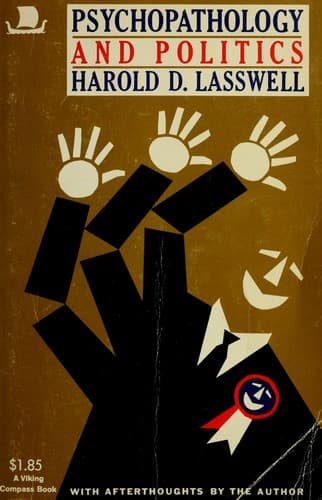
Psychopathology and politicsLasswell, Harold D. (Harold Dwight)
Science
Psychopathology and politics
Lasswell, Harold D. (Harold Dwight)
Personality and politics; Political science; Psychoanalysis; Psychology, Pathological
The recognition that people are poor judges of their own interest is
often supposed to lead to the conclusion that a dictator is essential.
But no student of individual psychology can fail to share the
conviction of Kempf that “Society is _not_ safe.... when it is forced
to follow the dictations of one individual, of one autonomic apparatus,
no matter how splendidly and altruistically it may be conditioned.”
Our thinking has too long been misled by the threadbare terminology of
democracy versus dictatorship, of democracy versus aristocracy. Our
problem is to be ruled by the truth about the conditions of harmonious
human relations, and the discovery of the truth is an object of
specialized research; it is no monopoly of people as people, or of the
ruler as ruler. As our devices of accurate ascertainment are invented
and spread, they are explained and applied by many individuals inside
the social order. Knowledge of this kind is a slow and laborious
accumulation.
The politics of prevention does not depend upon a series of changes in
the organization of government. It depends upon a reorientation in the
minds of those who think about society around the central problems:
What are the principal factors which modify the tension level of the
community? What is the specific relevance of a proposed line of action
to the temporary and permanent modification of the tension level?
The politics of prevention will insist upon a rigorous audit of the
human consequences of prevailing political practices. How does politics
affect politicians? One way to consider the human value of social
action is to see what that form of social action does to the actors.
When a judge has been on the bench thirty years, what manner of man has
he become? When an agitator has been agitating for thirty years, what
has happened to him? How do different kinds of political administrators
compare with doctors, musicians, and scientists? Such a set of
inquiries would presuppose that we were able to ascertain the traits
with which the various individuals began to practice their rôle in
society. Were we able to show what certain lines of human endeavor did
to the same reactive type, we would lay the foundation for a profound
change in society’s esteem for various occupations.
Public-domain text, read in full here on John Shaqi.
Reviews
Reviews
No reviews yet
Be the first to share your thoughts on this work.
Elsewhere in the archive
Join the Discussion
Join the discussion
Sign in to leave a comment or review.
Sign InorCreate an account