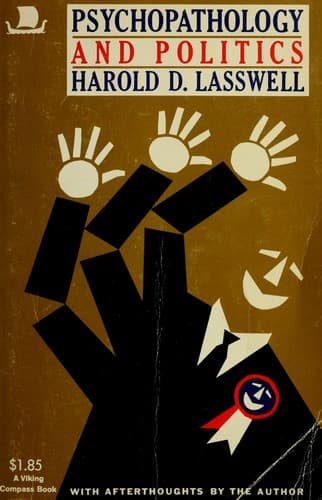
Psychopathology and politicsLasswell, Harold D. (Harold Dwight)
Science
Psychopathology and politics
Lasswell, Harold D. (Harold Dwight)
Personality and politics; Political science; Psychoanalysis; Psychology, Pathological
Any audit of the human significance of politics would have to press far
beyond the narrow circle of professional politicians. Crises like wars,
revolutions, and elections enter the lives of people in far-reaching
ways. The effect of crises on mental attitude is an important and
uncertain field. Thus it is reported that during the rebellion of
1745-46 in Scotland there was little hysteria (in the technical
pathological sense). The same was true of the French Revolution and of
the Irish Rebellion. Rush reported in his book _On the Influence of the
American Revolution on the Human Body_ that many hysterical women were
“restored to perfect health by the events of the time.” Havelock Ellis,
who cites these instances, comments that “in such cases the emotional
tension is given an opportunity for explosion in new and impersonal
channels, and the chain of morbid personal emotions is broken.”[53]
The physical consequences of political symbolism may be made the topic
of investigation from this point of view:
When the affect can not acquire what it needs, uncomfortable
tensions or anxiety (fear) are felt, and the use of the symbol or
fetish, relieving this anxiety, has a marked physiological value
in that it prevents the adrenal, thyroid, circulatory, hepatic and
pulmonic compensatory strivings from becoming excessive.[54]
Political programs will continually demand reconsideration in the light
of the factors which current research discloses as bearing upon the
tension level. Franz Alexander recently drew attention to the strains
produced in modern civilization by the growing sphere of purposive
action. He summed up the facts in the process of civilized development
in the following way: “Human expressions of instinct are subject to
a continual tendency to rationalization, that is, they develop more
and more from playful, uncoordinated, purely pleasure efforts into
purposive actions.” The “discomfort of civilization” of which Freud
recently wrote in the _Unbehagen der Kultur_ is characteristic of the
rationalized cultures with which we are acquainted. Life is poor in
libidinal gratifications of the primitive kind which the peasant,
who is in close touch with elementary things, is in a position to
enjoy.[55] Modern life furnishes irrational outlets in the moving
picture and in sensational crime news. But it may be that other means
of relieving the strain of modern living can be invented which will
have fewer drawbacks.
Public-domain text, read in full here on John Shaqi.
Reviews
Reviews
No reviews yet
Be the first to share your thoughts on this work.
Elsewhere in the archive
Join the Discussion
Join the discussion
Sign in to leave a comment or review.
Sign InorCreate an account