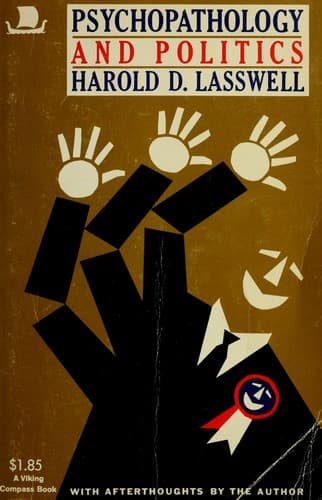
Psychopathology and politicsLasswell, Harold D. (Harold Dwight)
Science
Psychopathology and politics
Lasswell, Harold D. (Harold Dwight)
Personality and politics; Political science; Psychoanalysis; Psychology, Pathological
The following classification of political attitudes is intended to
have suggestive value rather than formal completeness. The first
section of this classification refers to the political preferences
and expectations or forebodings of the individual investigated.
Some individuals cherish a fraternal and some a paternal ideal. The
anarchist, socialist, and democrat talk the language of equality among
a family of brothers; the monarchists preserve a father.[75] A series
of other ideological distinctions are perhaps sufficiently clear from
the terms used.
CLASSIFICATION OF POLITICAL ATTITUDES
SECTION A. POLITICAL VIEWS
I. Preferences
Paternal ideal
Fraternal ideal
Strong central authority
Weak central authority
Revolutionary ideal
Counter-revolutionary or reactionary ideal
Cataclysmic change
Evolutionary change
Indulgent toward coercion, secrecy, ruthlessness
Insistent upon persuasion, openness, scrupulousness
Emancipatory, defensive, expansive ideal for group
World-unity ideal
II. Expectations and forebodings
Small political change can have great results
Small political change can have some results of value
Little of value can be accomplished by politics
Revolutionary changes imminent, eventual, contingent
It is probably in relation to political practices, as distinguished
from political views, that the intensive study of the individual
has the most to offer. I have included a list of questions in
Appendix B which are intended to suggest the sort of thing which
is directly pertinent to the interest of the political scientist
in this regard. How has the individual acted as a subordinate when
confronted by superiors of various kinds (in the army, in school, in
fraternity organizations, in business, in party clubs, in propaganda
organizations, in administrative hierarchies, and the like)? How has
the individual acted as a superior when confronted by subordinates
of various kinds? Besides considering the behavior of the person as
subordinate or superior, we may inquire into his attitude toward
individuals who have not been members of his various organizations,
but who have been possible helpers or obstacles. Thus he may have
approached strangers for money, or sought to win diplomatic support
from another organization against a common menace. His tactics may be
classified according to the means employed and the measure of success
attained. Special attention may likewise be devoted to the behavior
of the individual, not toward particular persons, but toward publics,
which are necessarily anonymous. Summarizing:
SECTION B. POLITICAL PRACTICES
I. As subordinate
Confronted by superiors who are
A. Strong, brutal
B. Masterful but rather objective
C. Weak
Reaction (conscious)
Public-domain text, read in full here on John Shaqi.
Reviews
Reviews
No reviews yet
Be the first to share your thoughts on this work.
Elsewhere in the archive
Join the Discussion
Join the discussion
Sign in to leave a comment or review.
Sign InorCreate an account