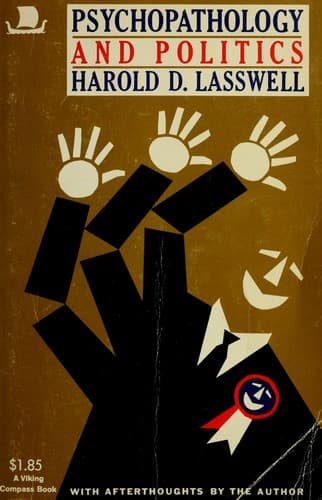
Psychopathology and politicsLasswell, Harold D. (Harold Dwight)
Science
Psychopathology and politics
Lasswell, Harold D. (Harold Dwight)
Personality and politics; Political science; Psychoanalysis; Psychology, Pathological
even rather casual acquaintances of certain kinds. Such knowledge will
enable research to proceed with more certain pace toward the time when
we shall know what to look for and how to elicit what we want with the
maximum of economy. The specialist who interviews a man for an hour may
be able, during the course of what appears to be an ordinary social
relation, to find the tell-tale signs which detailed research has shown
to be invariably, or almost invariably, connected with particular
impulse systems and developmental histories. As Bjerre so well put it:
As soon as our intercourse with a certain person is no longer
governed by common interests, but by a desire to acquire a
knowledge of his inmost being, we immediately abandon the formal
content of his utterance and begin unconsciously to seek for
whatever indication of his inner life appears in his speech
independently of, or even in spite of, his conscious will.[76]
What is achieved is a correlation of the results of “casual” contact
and “intensive” study, a correlation which is the common target of a
converging attack upon the understanding of the human personality.
Some day we shall know how to validate the saying of the old physician
which is on the title-page of this book: “From him who has eyes to
see and ears to hear no mortal can hide his secret; he whose lips are
silent chatters with his fingertips and betrays himself through all his
pores.”
CHAPTER XIII
THE STATE AS A MANIFOLD OF EVENTS
Implications have continually been drawn in the foregoing pages
about the bearing of the intensive study of individual personalities
upon the meaning of the political process as a whole. Since the
psychopathological approach to the individual is the most elaborate
procedure yet devised for the study of human personality, it would
appear to raise in the most acute form the thorny problem of the
relation between research on the individual and research upon society.
We are therefore justified in devoting more extended attention to the
theoretical problem involved than we have yet taken occasion to do.
It may be asserted at the outset that our thinking is vitiated unless
we dispose of the fictitious cleavage which is sometimes supposed to
separate the study of the “individual” from the study of “society.”
There is no cleavage; there is but a gradual gradation of reference
points. Some events have their locus in but a single individual, and
are unsuitable for comparative investigation. Some events are widely
distributed among individuals, like breathing, but have no special
importance for interpersonal relations. Our starting-point as social
scientists is the statement of a distinctive event which is widely
spread among human beings who occupy a particular time-space manifold.
Public-domain text, read in full here on John Shaqi.
Reviews
Reviews
No reviews yet
Be the first to share your thoughts on this work.
Elsewhere in the archive
Join the Discussion
Join the discussion
Sign in to leave a comment or review.
Sign InorCreate an account