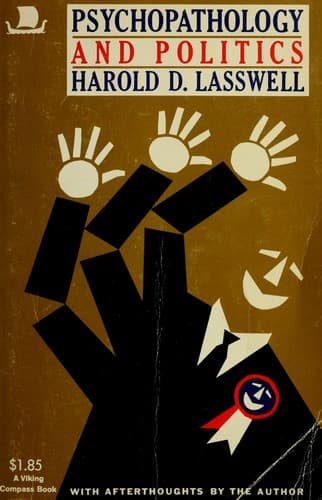
Psychopathology and politicsLasswell, Harold D. (Harold Dwight)
Science
Psychopathology and politics
Lasswell, Harold D. (Harold Dwight)
Personality and politics; Political science; Psychoanalysis; Psychology, Pathological
Thus far in his development the growing individual has not become
socialized in the sense that he has become self-regulating in
relation to objects in the environment. The infant learns “sphincter
morality” (in the phrase of Ferenczi), but this involves no emotional
relationship to objects. His pleasures remain on his own body
(autoplastic), and the environment is an instrument for removing bodily
tensions in the simplest manner. Gradually the child begins to look for
gratification by lively erogenous activities upon the body of another.
This outward push of activity is again limited and frequently blocked
by _force majeur_. In the place of sexual relations to objects there
now appears a new form of relation, and the child socializes himself by
incorporating the practices of those about him.
It will be remembered that emotional bonds are established in two
ways: by object choice (for sexual acts) and by identification.
Identification, Freud writes, is the original form of emotional tie
with an object. It can become a substitute for a libidinal object tie,
and it may arise with every new perception of a common quality shared
with some other person who is not an object of the sexual instinct.
This latter is partial identification. The qualities of the object are
copied (introjected). The energy for the identification is said to be
supplied by aim-inhibited sexual instincts. The name of the state, the
ceremonial acts of deference toward ceremonial symbols--all this and
much more is characteristically a feature of the child’s growth.
Characteristic, that is to say, frequent, but not invariable. Children
are always brought in relation to a system of interferences and
indulgences (ways of raising children), and they always perceive an
order of some kind. But in some cases when a nation lives subjected to
a state, the recognition of the state relation may be accompanied by
resentment.
The state pattern itself prevails when many people take it as more than
a mere state of affairs, and the idea is reinforced by “irrelevant
meanings.” Some individuals impose motivations upon others through the
state pattern. These individuals, whether despots or enthusiasts, may
be termed “radicles,” the active ones who serve as radiating centers
for the preservation and amplification of the state pattern.
Public-domain text, read in full here on John Shaqi.
Reviews
Reviews
No reviews yet
Be the first to share your thoughts on this work.
Elsewhere in the archive
Join the Discussion
Join the discussion
Sign in to leave a comment or review.
Sign InorCreate an account