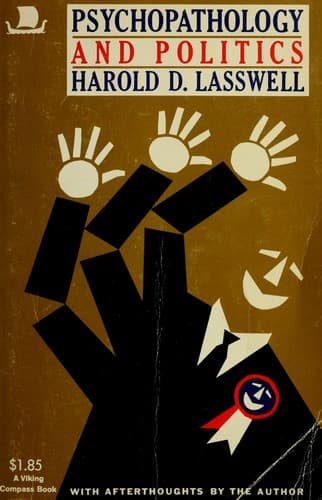
Psychopathology and politicsLasswell, Harold D. (Harold Dwight)
Science
Psychopathology and politics
Lasswell, Harold D. (Harold Dwight)
Personality and politics; Political science; Psychoanalysis; Psychology, Pathological
The full import of this observation did not instantly dawn on Freud.
But he continued to have difficulties with the patients whom he sought
to hypnotize. They sometimes held out against his suggestions, even
though they had accepted them many times before, and seriously impeded
the progress of the search for the traumatic episode. He gradually
abandoned hypnosis, leaving the patient in a waking state in a relaxed
position with instructions to report every incident connected with the
early appearance of the symptom under investigation. Vestiges of the
hypnotic technique remained as late as 1895, when he would still lay
his hand on the patient’s forehead as a stimulus to recollection.
This method also encountered crippling difficulties. A patient would
sometimes lie for hours without saying a word, totally unable to
recover a relevant reminiscence. To meet this obstacle, Freud presently
hit upon the simple expedient upon which he thenceforth relied. He
instructed the patient to say anything and everything that popped in
his head, regardless of its propriety, logic, or triviality.
Freud found that all ramblings of his patient could furnish him with
clues to the underlying and unavowed impulses of the sufferer. He
became able to guess the nature of the buried episode in which the
impulse had received its present type of manifestation. Thus the
patient might begin by saying that she had seen a red-headed man in the
street and that she always despised red-headed men--except of course
her dear brother. Day after day apparently random allusions would build
out the picture of her great interest in anything reminiscent of her
brother’s looks and acts, all of which would be bitterly condemned. But
if she were asked directly, she would maintain that her brother was a
fine, upstanding man, and a credit to the family.
The analyst, after listening to the eddies of talk, and noting the
patterns along which they seemed to whirl, would presently locate
a hidden rock beneath the innocent surface of the stream--in this
case, an unacknowledged load of hatred against her brother. Bit by
bit, stories of real or fancied childhood tyranny would come floating
along the stream. Then suddenly, amid tears and violent gestures,
might come the story of a long-forgotten incident which involved an
intimate aggression on the part of the brother. The patient, manifestly
relieved, might speedily recover from her hysterical disabilities and
return to the active responsibilities of life.
Public-domain text, read in full here on John Shaqi.
Reviews
Reviews
No reviews yet
Be the first to share your thoughts on this work.
Join the Discussion
Join the discussion
Sign in to leave a comment or review.
Sign InorCreate an account