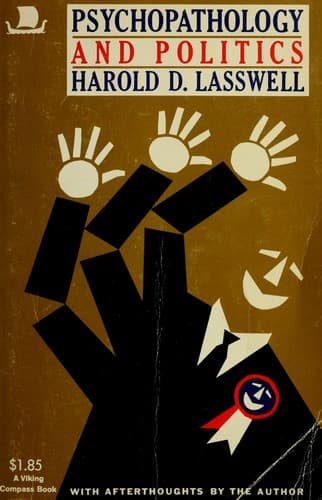
Psychopathology and politicsLasswell, Harold D. (Harold Dwight)
Science
Psychopathology and politics
Lasswell, Harold D. (Harold Dwight)
Personality and politics; Political science; Psychoanalysis; Psychology, Pathological
Freud’s theory of what he saw began modestly enough, leaned heavily
upon Charcot, Bernheim, and Breuer, and was mostly founded upon
observations made upon patients who were handled by hypnosis and not by
the new procedure which later was called psychoanalysis. He published a
contribution to the theory of the psychoneuroses in which he laid down
the proposition that a distinction could be drawn between one group,
the anxiety neuroses, which depended on mental conflict, and the actual
neuroses, which were not due to mental conflict but to masturbation and
coitus interruptus. In the first case, mental energy was converted into
bodily symptoms, and in the latter case bodily energy was supposed to
be converted into bodily symptoms. In Freud’s early articles there is
little to forecast the course which he was to follow as his brilliant
imagination viewed the behavior of the individual from the new vantage
ground which he had discovered.[5]
Whether his particular theories survive or fall, the standpoint which
he achieved by ruthlessly applying his method is of the greatest
value. His method, which grew from the necessities of an exasperated
physician, led him _systematically to treat every manifestation of
the individual as part of a related whole_. Freud’s mental set had
been furnished by the data of hypnosis, which seemed to show that
patients suffer from reminiscences. When he dropped hypnosis and tried
to force recollections, his mental set had not altered, for he was
still in search of the original, the traumatic episode. When he asked
his patients to say anything that came into their heads, he was still
hunting the elusive memory of a definite early experience. But quite
without realizing it, his original mental set had widened, and with
momentous consequences for his own subsequent development. If one were
given to exaggerations, one could say that the world of psychological
investigation had suddenly begun to turn on a new axis.
What was the nature of this new mental set? Intently watching his
patients, not for word for word accounts of what had happened, and
looking upon everything else as “irrelevant,” Freud learned to look
for meanings and not for reports. Every dream, every phrase, every
hesitation, every gesture, every intonation, every outburst began
to take on significance as possible allusions to the “traumatic”
episode. Allusions to hated objects, reminiscent of a brother, failure
to mention a hated sister until days had passed, although other
members of the family had been passed in review--every deviation from
comprehensiveness--was eagerly scrutinized for the clue it might afford.
Public-domain text, read in full here on John Shaqi.
Reviews
Reviews
No reviews yet
Be the first to share your thoughts on this work.
Join the Discussion
Join the discussion
Sign in to leave a comment or review.
Sign InorCreate an account