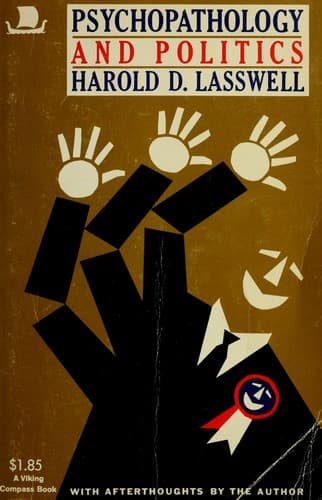
Psychopathology and politicsLasswell, Harold D. (Harold Dwight)
Science
Psychopathology and politics
Lasswell, Harold D. (Harold Dwight)
Personality and politics; Political science; Psychoanalysis; Psychology, Pathological
Freud treats the state as an emotional unity.[84] The members of the
state identify themselves with an abstract object (the idea of the
state) and are bound emotionally by the partial identification which
arises in perceiving an analogous relationship to the object. Kelsen
has objected to this conception of the state as a real subjective unity
by arguing that identification is a process between individuals, and
that each member of a state cannot be thought of as having entered into
personal relationships with every other member. Even if his narrow
construction of identification were well founded, the state could still
be treated as a real subjective unity on the basis of interlocking
identifications. A has identified with B and B with C, and one of the
features of B which the child A would typically take over (introject)
would be the name and other symbols of the state.
Indeed, it is the interlocking character of identifications which
reasonably insures the incorporation of the state symbol into the
child’s conception of himself. There is such a process as negative
identification, the rejection of patterns which are connected with
hated persons. The child is usually exposed to many adults and
contemporaries, and if they all associate themselves with the state,
the child is almost certain to reject only those patterns which pertain
exclusively to the hated individuals. This is the fundamental reason
for the staying power of patterns once accepted in a group.
It has been customary in the psychoanalytical literature on social
and political processes to describe the state as a universal
father-substitute. We are at length in a position to discuss the
problems raised by such a generalization. The distinctive contribution
of the psychopathological approach is the plurality of individual
meanings which it discloses. It is an anticlimax to discover that
the appearance of diversity is, after all, spurious, and that those
who insist upon the strenuous simplification of human motives are
justified. The point which I wish to insist upon is that the data
revealed by the psychopathological procedure are far more significant
for political and social science than this single-track generalization
would lead one to suppose.
Public-domain text, read in full here on John Shaqi.
Reviews
Reviews
No reviews yet
Be the first to share your thoughts on this work.
Elsewhere in the archive
Join the Discussion
Join the discussion
Sign in to leave a comment or review.
Sign InorCreate an account