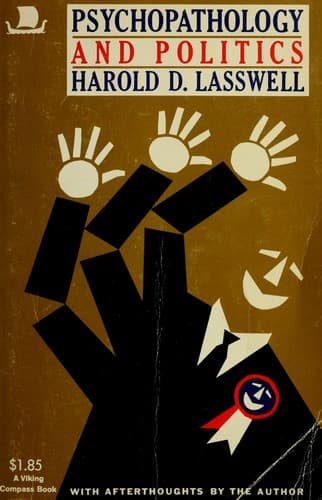
Psychopathology and politicsLasswell, Harold D. (Harold Dwight)
Science
Psychopathology and politics
Lasswell, Harold D. (Harold Dwight)
Personality and politics; Political science; Psychoanalysis; Psychology, Pathological
The special value of the psychopathological approach is that it
represents a supermicroscopic method of utilizing individual instances
for the study of culture patterns. If we begin with a political pattern
and view it against the private histories of actual people, we find
that this pattern takes on variable meaning from one individual to
another, but that broad groupings of associated meanings are possible
of ascertainment. Any subjective event which is frequently associated
with a political pattern is important. Valid generalizations depend
upon multiplying cases which are selected from different groups in
the culture, and which are studied by methods capable of disclosing
subjective contexts. This is the point where quantitative procedures
can be made profitable to the student of culture, whose attention is
riveted on patterns whose subjective element is important.
But are these studies likely to lead to anything valuable if subjective
events are so variable that any subjective event may be associated
with any other subjective event? Why not terminate the investigation
at the outset by saying that the general law of probabilities can be
relied upon to predict the frequency with which any two of a number
of specified subjective events may be expected to occur together?
Is not our empirical inquiry likely to terminate in an inventory
of subjective states and their frequently accompanying movements,
thus foredooming any effort to discover more-frequent-than-chance
simultaneities, antecedents, and successions? If you look long enough,
won’t you find every subjective event associated with every other one?
A great many facts tend to substantiate this point of view. It is true
that many imposing psychological schools of thought have arisen, run
swiftly for a time in narrow channels, and then stagnated in a shallow
pool of “faculties” or “instincts,” mere inventories of patterns which
are abstracted from all concrete events and which are therefore capable
of being combined in any event in nearly infinite combinations. The
search for specific connections slacks down, and the psychological mill
pond is only stirred when somebody throws a stone in the pool in the
form of a new theory of specific causation, which troubles the waters
until it is found that the specific event is found to occur with only
chance frequency. In this sense the only contributors to psychology
are those who are sufficiently naïve, or sufficiently unscrupulous,
to exaggerate the rôle of a specific type of experience. So we have
psychologies based on “fear” or “love” or “imitation,” or we have a
long string of separate terms, “sub-fears,” which multiply as the range
of concrete observation widens, and the failure of the selected factor
to explain everything is made manifest, or disguised.
Public-domain text, read in full here on John Shaqi.
Reviews
Reviews
No reviews yet
Be the first to share your thoughts on this work.
Elsewhere in the archive
Join the Discussion
Join the discussion
Sign in to leave a comment or review.
Sign InorCreate an account