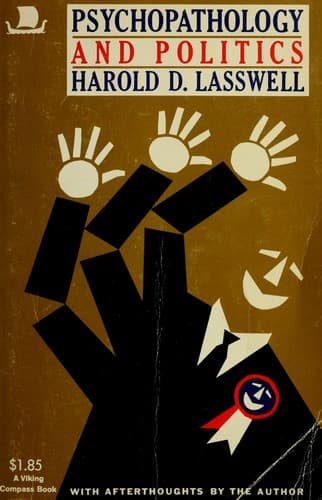
Psychopathology and politicsLasswell, Harold D. (Harold Dwight)
Science
Psychopathology and politics
Lasswell, Harold D. (Harold Dwight)
Personality and politics; Political science; Psychoanalysis; Psychology, Pathological
Thus a history of psychology could be written by taking “completed”
systems, analyzing the functional equivalence of the categories
applied, and reducing every new system to a collection of synonyms
for the terms of preceding systems. This hypothetical history of
psychological theories would show how an inquirer, much impressed by
certain experiences, would seize upon certain terms to describe them,
and how, confronted by more and more empirical realities, he would
modify the distinctive meaning of his explanatory conceptions out of
existence. A history of psychoanalytic terminology, such as Rank has
sketched in his treatment of genetic psychology, might be raw material
for such a comparison.
Would nothing remain but dictionaries of synonyms, all rather dubious
contributions to the grist of linguistic research? It might be that
our projected history would show that each psychological system left
a permanent legacy behind it in the form of a significant “mechanism”
which had not previously been stressed. Now the whole world of
“causation” is implicated in any event, and the whole number of
significant mechanisms which may be discerned in the “mind at a moment”
is infinite. So our hypothetical volume might conclude by accepting the
assumption that some events can be brought about by more than chance
frequency, subject to the reservation that experimental confirmation is
never reliable as to the future. The critical configurations may never
“reappear.” We commonly say that the probability of an event’s future
repetition is greater if it has been oft repeated in the past. But
there is no means of demonstrating that the future contains analogous
configurations to the elapsed. The probability of the future repetition
of an event is “no probability.” If events appear to be predictable,
this is so because our knowledge of contingencies is limited, and our
sequences of similar configurations may still be treated as special
instances of “no sequence.” The stable is a special case of the
unstable, to put the ultimate paradox. The discovery of aggregates
of mechanisms whose rearrangement in short periods would enrich the
apparatus of social control is the dream (the mirage?) of psychology.
Whether these objections will be well founded depends on the outcome
of the test, and are incapable of dialectical resolution. It may be
pointed out that the search for generalized mechanisms rests on no
firmer logical foundations than the search for subjective sequences,
since mechanisms are likewise aspects of the world of events, and as
such are subject to the same “no probability” laws of recurrence.
Public-domain text, read in full here on John Shaqi.
Reviews
Reviews
No reviews yet
Be the first to share your thoughts on this work.
Elsewhere in the archive
Join the Discussion
Join the discussion
Sign in to leave a comment or review.
Sign InorCreate an account