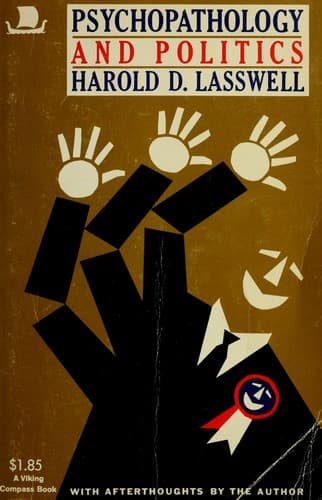
Psychopathology and politicsLasswell, Harold D. (Harold Dwight)
Science
Psychopathology and politics
Lasswell, Harold D. (Harold Dwight)
Personality and politics; Political science; Psychoanalysis; Psychology, Pathological
But this connotation requires generalization and revision. The road to
power in our civilization is by no means an exclusively governmental
highway, for technical implements have scattered authority and created
an industrial feudality. The directors of large corporations have to
make decisions which are far more important for the daily happiness of
mankind than most of the decisions of governments. Since government is
so largely the agent of corporations, the government is hardly master
in its own house.
The concept of the statesman has long carried the implication that
anyone who exercises social power outside the government is in hot
pursuit of an exclusively private advantage. Is this any longer
tenable? Is there not such a thing as the “institutionalization of
business” which arises when a given enterprise plans to operate
indefinitely and is thus forced to calculate its interests over long
periods of time? One of the major elements in this calculation is the
necessity of taking precautions against a withdrawal of favor on the
part of the community at large. This is the core of the political way
of thinking, and assimilates the policy of aggregations of private
power to that of the state which is guided by statesmen. It is timely,
therefore, to disentangle the concept of statesmanship from its
historical association with a single institution.
Some of the many senses in which the “politician” is used may be
disposed of by drawing a clean distinction between the “business
man” and the “politician.” The business man may be defined as one
who pursues a private advantage with little regard for conceptions
of public right. The politician, in the here-selected “best” sense
of the word, uses persuasion on behalf of his conception of public
right. The politician pursues a genuine integration of interests in
the community; the business man is satisfied with a compromise among
competing private interests. The importance to political theory of the
distinction between integration and compromise has quite properly been
stressed by Mary L. Follett.[15] An integration of interests is the
solution of a conflict in such a way that neither “party” recognizes
that so much has been won and so much has been lost in the outcome.
It represents a reinterpretation of the situation in a sense which
renders the old line of battle, the older definition of interest,
irrelevant. It is illustrated when a wage controversy is disposed of by
the decision to try to divide the advantages of economies in production
which may be brought about through new co-operative procedures. The
essence of the contrast between integration and compromise is that
between a synthesis and a trade. The politician is a discoverer of
inclusive advantages, and the business man is a higgler for special
advantages. Whether, as Adam Smith said, an invisible hand shapes a
social synthesis from the general pursuit of private profit, we do
not have to decide upon here.
Public-domain text, read in full here on John Shaqi.
Reviews
Reviews
No reviews yet
Be the first to share your thoughts on this work.
Join the Discussion
Join the discussion
Sign in to leave a comment or review.
Sign InorCreate an account