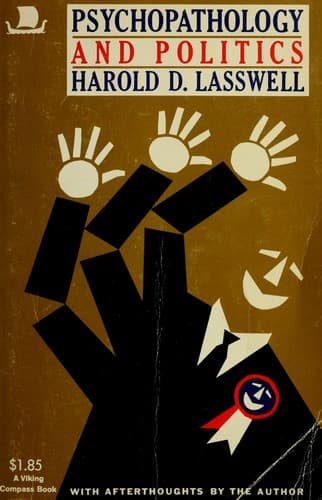
Psychopathology and politicsLasswell, Harold D. (Harold Dwight)
Science
Psychopathology and politics
Lasswell, Harold D. (Harold Dwight)
Personality and politics; Political science; Psychoanalysis; Psychology, Pathological
It follows from what has been said that the study of politicians who
are chosen from a single institutional process makes a contribution
to the general study of politicians in every institutional process,
and that the conscious abstraction of categories until they are
comprehensive opens a wider range of exact comparison. This may
eventuate in an actual simplification of some fundamental conceptions.
Of course, institutional processes differ in the scope which they give
to certain human drives. Today the church offers less opportunity for
the use of physical violence than it did in the sixteenth century, and
very much less opportunity than the police force, the private detective
agency, or the political gang.
The advantages of comprehensiveness and possible simplification have
been sacrificed by the political scientists of the schools because
they have conceived their task in too narrow a spirit. They have
been slow in studying the manifestations of human nature in politics
because they have been saturated with sectarian pride in legal and
philosophical distinctions; or they have checked their theories with
their coats, and plunged into technical work. A body of theory which
interacts fruitfully with philosophy, law, and technology is still very
poorly developed. The formal sociological systems have been sacked for
“premises” but neglected for hypotheses. (Witness the exploitation of
the concept of “solidarity” in recent juridical theory.) The task of
the hour is the development of a realistic analysis of the political in
relation to the social process, and this depends upon the invention of
abstract conceptions and upon the prosecution of empirical research.
It is precisely this missing body of theory and practice which Graham
Wallas undertook to supply in England and which Charles E. Merriam
has been foremost in encouraging in the United States. It is the
deficiency which led Catlin to propose to substitute what I would
call the “functional” for the “institutional” definition of the field
of political science.[14] This necessarily implies a new respect for
the possibilities of using the ingenious suggestions to be found in
the sociological systematists, a new curiosity about diverse ways of
approaching events, and a new sympathy for parallels to institutional
phenomena.
Various obscurities can be removed if we generalize our terms
from the narrowly institutional to the broadly functional plane.
Terms like “statesman” and “despot” were minted of the metal of
political experience in communities where the high road to power was
governmental. It is true that in Athens it was difficult to draw very
sharp lines between governmental and other forms of communal activity,
on account of the intimate interlacing of all institutional processes.
Nevertheless, terms like “statesman” and “despot” came to refer to
forms of political activity in a narrowly institutional sense, and such
is their connotation today.
Public-domain text, read in full here on John Shaqi.
Reviews
Reviews
No reviews yet
Be the first to share your thoughts on this work.
Join the Discussion
Join the discussion
Sign in to leave a comment or review.
Sign InorCreate an account