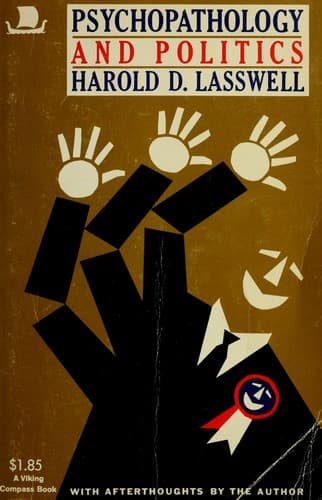
Psychopathology and politicsLasswell, Harold D. (Harold Dwight)
Science
Psychopathology and politics
Lasswell, Harold D. (Harold Dwight)
Personality and politics; Political science; Psychoanalysis; Psychology, Pathological
in fostering the interests of some collectivity. The god of the
political man in religion is a god of might who requires mighty men to
serve him.
In developing his image of the _homo politicus_, Spranger is
fully aware that his “pure” type seldom exists. The bold, frank
aggrandizement of self is rarely tolerated in society, for “the
greatest power manifests itself as collective power,” and the man
who cherishes power must achieve some measure of socialization or
he is outlawed. Although in principle no warm-hearted lover of his
fellow-men, he must keep his contempt to himself or feign expansive
sentiments of group loyalty. Indeed, self-deception is perhaps the
rule, for the political personality with a strong artistic component
possesses a florid imagination which dramatizes his personal history
and subordinates all reality to ambitious plans. It seems to me that
Spranger does not sufficiently stress this aspect of the political man,
this large capacity for playing the impostor upon himself and others.
The gist of Spranger’s generalization of the political man is
schematically expressible in terms of desire-method-success. The
political man desires to control the motives of others; his method may
vary from violence to wheedling; his success in securing recognition in
some community must be tangible. These are the nuclear relations which
are essential to the type definition.
Naturally there are a number of necessary annotations to be made on
this formula. Sometimes the man with a thirst for power is unable to
indulge and quench his thirst, for his physical and social equipment
may be too meager. And how are we to appraise results? _Wer regiert
denn?_ Power over others is partially exercised by every living being;
but in any hierarchy of the powerful, some are on the lowest tier, if
current social criteria be applied. The bedridden, complaining wreck
may be of no significance except as a burden upon the care of a single
nurse. Accepting the current values of society, such an individual
would be on the very bottom of the heap. And yet, as Alfred Adler
has so often insisted as to make the point peculiarly his own, the
hysteric may use his symptoms to win a high degree of submission from
his immediate environment, and this may be all that he cares about. And
some of those who give up the visible struggle for social influence may
retire to distil their bile into poisoned darts against the pursuit
of external pomp, and secure reputation and eminence by embodying the
results in sparkling rhetoric.
Public-domain text, read in full here on John Shaqi.
Reviews
Reviews
No reviews yet
Be the first to share your thoughts on this work.
Join the Discussion
Join the discussion
Sign in to leave a comment or review.
Sign InorCreate an account