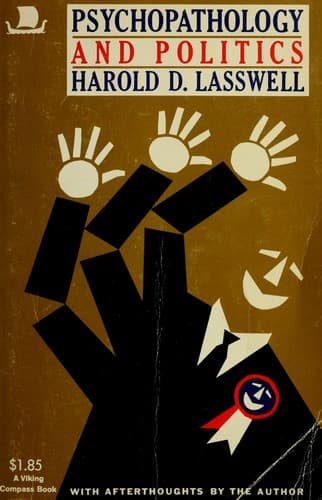
Psychopathology and politicsLasswell, Harold D. (Harold Dwight)
Science
Psychopathology and politics
Lasswell, Harold D. (Harold Dwight)
Personality and politics; Political science; Psychoanalysis; Psychology, Pathological
The man who runs his village may become more acutely aware that he does
not run the county; and when he runs the county, that he does not run
the province; and so on up the ladder. His appurtenances of power may
be deferred to by those about him, yet his own soul may smart with
the shackles of a larger slavery. Thus, Spranger is right in saying
that, when one succeeds in penetrating the psychology of the search
for power, it becomes comprehensible that he whose nature is bound
up in the pursuit of authority is most keenly sensible to the limits
of his own freedom, and consequently suffers so keenly from nothing
else in life than his own subordination. Sensing this, the Stoics long
ago contended that the essence of liberty is the self-sufficiency
which makes no demands on others. Ascendancy involves dependence,
a reciprocal relationship which has been exhaustively described
by Simmel.[18] But there are some who combine easy success with
indifference. These are no doubt recruited from among those who have
natural suggestive power to certain groups--they possess the _charisma_
of Max Weber.[19]
Allowing for these annotations, the nucleus of Spranger’s thinking may
be repeated. The _homo politicus_ is characterized by the following
relationship between desire, method, and success: desire to control
the motives of others; methods varying from violence to wheedling; and
success in securing communal recognition.
Spranger’s subtle comments in elaborating this simple, central
conception are among the most valuable in the literature of society.
Starting from bold simplifications, he succeeds in formulating pictures
which give richer meaning to the details of political life in all
the institutional processes of culture. Of course the literature of
political science is full of types which are described as Spranger
has described the political man. Michels and Merriam have listed the
qualities which they find in political leaders as a class. Conway has
propounded his familiar trichotomy: crowd-compellers, crowd-exponents,
and crowd-representatives. The possibility of defining types according
to the reactionary, conservative, liberal, or radical nature of the
opinions championed has often been discussed.[20]
Public-domain text, read in full here on John Shaqi.
Reviews
Reviews
No reviews yet
Be the first to share your thoughts on this work.
Join the Discussion
Join the discussion
Sign in to leave a comment or review.
Sign InorCreate an account