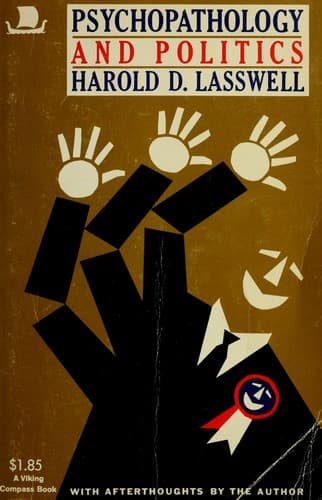
Psychopathology and politicsLasswell, Harold D. (Harold Dwight)
Science
Psychopathology and politics
Lasswell, Harold D. (Harold Dwight)
Personality and politics; Political science; Psychoanalysis; Psychology, Pathological
Certain conspicuous political types belong to Jung’s category of
extraverted thinkers. These individuals try to bring their whole
life-activity into relation with intellectual conclusions, which
in the last resort are always oriented by objective data, whether
objective facts or generally valid ideas. By his formula are good and
evil measured: all is wrong that contradicts it, and all is right
that corresponds to it; all is accidental that is neutral toward it.
Just as the extraverted thinking type subordinates himself to his
formula, he seeks to subordinate all others to it, as a manifestation
of a universal inspiration. His moral code forbids him to tolerate
exceptions, and he would bend all to suit the scheme. “One really
should” or “one must” figure largely in his program. If the formula is
wide enough, Jung remarks that the extraverted thinker may figure as a
reformer, a ventilator of public wrongs, and a propagandist. But the
more rigid his formula, the more likely he is to grow into a grumbler,
a crafty reasoner, and a self-righteous critic.
Many politicians answer to the general description which Jung gives
of the extraverted, intuitive type. The intuitive is unattracted by
the established values; he is drawn to the possible rather than to
the actual. He seizes hold of new objects and ways of doing things
with eager intensity, only to abandon them cold-bloodedly, when
their implications become obvious. The irresistible magnet of the
rising sun fires his imagination and guides his activity. For the
risen sun and the setting sun there is no enthusiasm, no special
hostility, only indifference. Here is the facile promoter, who senses
the dawning future and speeds from project to project, bored with
routine and detail after projects have been accepted and the blueprints
finished.[28]
The types of Apfelbach and Jung are based upon a small number of
reactive mechanisms which are supposed to influence in different degree
the growth of the personality. These “mechanism” types may contain
many useful leads, but the methodological problem in isolating these
hypothetical mechanisms is unsettled. A “stable” reaction in adulthood
may be far from stable when viewed at successive growth periods. These
“mechanism” types seem to encourage endless classificatory ventures
at the expense of detailed reporting of life-histories. For reasons
which have been set forth, subjective histories are of the greatest
importance to social science; and any excessive interest in “mechanism”
which minimizes the importance of elaborate individual records is to be
deplored. Jung and Apfelbach say very little about the principal epochs
of individual development, and distract attention from the career as a
whole, as this career is structuralized in successive phases.
Public-domain text, read in full here on John Shaqi.
Reviews
Reviews
No reviews yet
Be the first to share your thoughts on this work.
Join the Discussion
Join the discussion
Sign in to leave a comment or review.
Sign InorCreate an account