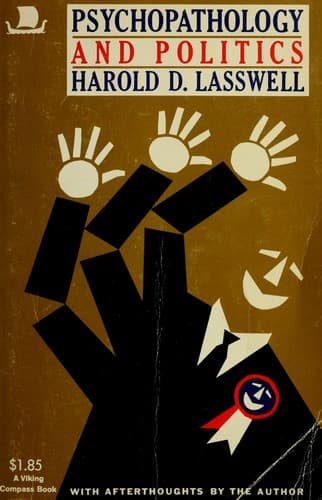
Psychopathology and politicsLasswell, Harold D. (Harold Dwight)
Science
Psychopathology and politics
Lasswell, Harold D. (Harold Dwight)
Personality and politics; Political science; Psychoanalysis; Psychology, Pathological
Before outlining our developmental conception of the _homo politicus_,
we return to the work of Freud, for his method has enabled him to
keep close to the subjective sequence and to use classificatory terms
in relation to the successive phases of impulse organization in the
developing personality.
CHAPTER V
THEORIES OF PERSONALITY DEVELOPMENT
It will be remembered that Freud’s search for signs of the traumatic
situation led him to uncover the contemporaneous functioning of all
sorts of unconscious motivations in both the diseased and the healthy
personality. The quest led him farther. Freud felt impelled to set
up a schematic representation of the typical genetic development of
the human personality. This grew out of the comparative study of very
thoroughly analyzed cases and was rooted in empirical observation.
Freud has always kept close to his data; and no matter how far his
imagination soared, actual clinical experience was the starting-place
and the landing-field for the flight.
The energy of a developed personality can be treated as dispersed in
three directions: in the affirmative expression of socialized impulses,
in unsocialized impulses, and in the maintenance of resistance charges
against unsocialized impulses. The original forms of energy expression
which are available to the infant are in many ways incompatible with
the demands of human intercourse. The infant must surrender many
primitive forms of gratification, if he is to be loved, and to avoid
discomfort and pain. He must build up a self which represents the
demands of society. The surrounding adults coerce and wheedle him
into taking their commands for his own laws. The conscience is the
introjected environment which imposes limitations upon the antisocial
impulses. As the infant and child grows, he avoids conflicts with the
environment by removing the locus of the conflict within himself, and
plays nurse, mother, and father to himself. He learns to control his
own excretions and to chasten his own murderous rages. He achieves
individuality of emphasis by accepting the socialization of his major
impulses.
But this incorporation of the requirements of the social order into
the personality does not proceed smoothly, nor does it abolish the
primitive psychological structures which have been developed and
apparently discarded at each step of the way toward adulthood. Much
of the energy of the personality is spent in blocking the entry of
the unadjusted impulses of the self into consciousness and into
overt expression. Careful scrutiny of individual behavior over a
twenty-four-hour period strikingly shows the extent to which the
personality is controlled by very elementary psychological structures.
Moments of fatigue, moments of deprivation, moments of irresponsible
reverie, all betray the presence of tendencies which are unassimilated
to the world of adult reality.
Public-domain text, read in full here on John Shaqi.
Reviews
Reviews
No reviews yet
Be the first to share your thoughts on this work.
Join the Discussion
Join the discussion
Sign in to leave a comment or review.
Sign InorCreate an account