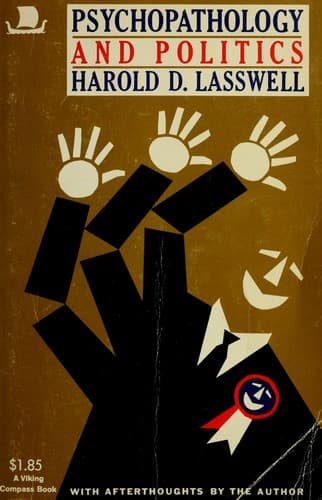
Psychopathology and politicsLasswell, Harold D. (Harold Dwight)
Science
Psychopathology and politics
Lasswell, Harold D. (Harold Dwight)
Personality and politics; Political science; Psychoanalysis; Psychology, Pathological
Freud began to build up his conception of personality development
by the gradual universalization of phenomena which he encountered
in actual clinical work, and which he first described in relatively
modest and restricted terms. He began his original psychological
contributions by stressing the rôle of sexuality in the etiology of
certain neuroses. He found that all sorts of pathological conditions
and developmental abnormalities were apparently due to some shortcoming
in sexual integration. This emphasis upon sexual adjustment as a
necessary prerequisite of healthy adulthood met with so much opposition
that Freud’s energies were taken up with defending and elaborating his
position. Now the sexual function is essentially a species function
and stresses the biological uniformities of man at the expense of
individuality. A topic like “personality development” requires a
comprehensive theory of individuality, and this Freud did not develop
until the split with Adler, who insisted upon the rôle of a drive
toward individualization and who denied that the much neglected “ego
instincts” of Freud were enough to support a comprehensive theory.
The story of Freud’s neurosis-sexuality-personality theories begins
with his earliest independent psychological contributions. Many
clinicians before Freud had been abundantly impressed by the frequency
with which sexual troubles seemed to beget “nervous” troubles. In
his hypnotic work, Freud was especially struck by the frequency with
which specifically sexual episodes were involved in the pathogenic
experiences. Freud now proceeded to generalize about the sexual element
in neurosis, and announced that neurosis was a function of deviated
sexual life.
Freud armed in defense of his generalization with two new weapons. The
first was his experience in letting his patients talk it out and in
treating most of their productions as symbolic of something else. He
acquired facility in interpreting what other people took literally as
being a disguised representation of something else. So, when Freud was
confronted with cases which were not manifestly sexual, he felt able to
treat the non-sexual elements as symbolic representations of sexuality
and to justify himself by claiming that his more intensive research
procedure supplied him with the sustaining facts. Needless to say,
those who had not themselves experienced the shift in standpoint which
Freud had achieved were alienated by his seeming arbitrariness.
Freud’s second reliance was on an inclusive theory of sexuality.
Undaunted by the ridicule heaped upon his sexual theory of the
neurosis, he carried the war into enemy territory by extending the
whole concept of sexuality backward from puberty through the life of
the growing child to infancy.
Public-domain text, read in full here on John Shaqi.
Reviews
Reviews
No reviews yet
Be the first to share your thoughts on this work.
Join the Discussion
Join the discussion
Sign in to leave a comment or review.
Sign InorCreate an account