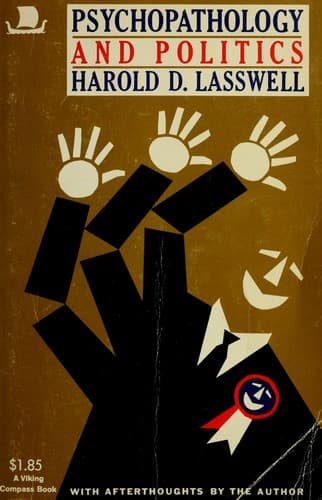
Psychopathology and politicsLasswell, Harold D. (Harold Dwight)
Science
Psychopathology and politics
Lasswell, Harold D. (Harold Dwight)
Personality and politics; Political science; Psychoanalysis; Psychology, Pathological
It is due to the growing emphasis upon the importance of understanding
the personality as a functioning whole that modern medical men are
willing and anxious to assemble data about the behavior of the
individual in his family, business, and recreational relations. Such
facts are often useful to the physician in making his diagnosis and
in deciding how to handle the patient. The modern emphasis upon the
rôle of reverie in developing one’s traits and interests has led
to the inclusion of data about night dreams, daydreams, ambitions,
grievances, enthusiasms, and loyalties of the subject. Not infrequently
the productions of the patient are recorded in his own words by a
stenographer who is present during certain interviews with physicians.
All these psychological and sociological data increase the significance
of the case record for the individual who studies it for the purpose of
understanding the total developmental history of the person.
Sometimes the case histories concern people who are without mental
disorder, but who have, for one reason or another, been committed for
observation. The German government was not the only one in the late war
which sometimes resorted to the expedient of avoiding the appearance of
internal dissension by referring pacifists to a mental hospital. The
records of the kind obtained under these circumstances are often of men
and women without pathology, and serve to control the conclusions which
rest on the study of pathological cases.
Quite often the specifically pathological features in the record of a
sick person are very meager. Thus, one prominent politician, the mayor
of a large city, was brought to a mental hospital suffering from an
alcoholic psychosis,[2] delirium tremens. He was only “insane” (to use
a nonscientific term) when he was passing through this acute alcoholic
episode, and was soon released. But the record of what he said and did
during the delirium casts a brighter light on the deeper motivations
of his political career than many pages of conventional biography. The
hallucinations and delusions which he experienced were not entirely
stereotyped for the disease. Since he was no longer able to maintain
his repressions, his inner fantasy life came out in the clear, and his
personality structure stood revealed. Another politician showed nothing
abnormal except a propensity for collecting women’s shoe heels, which
he found sexually stimulating. He came to the medical psychologist
to be freed from his fetishist perversion, and in so doing he made
possible the preparation of a document which intimately revealed the
origin of certain political interests. From the point of view of the
political scientist the most valuable parts of his history happened
to be quite far removed from the narrowly circumscribed pathological
symptoms.
Public-domain text, read in full here on John Shaqi.
Reviews
Reviews
No reviews yet
Be the first to share your thoughts on this work.
Join the Discussion
Join the discussion
Sign in to leave a comment or review.
Sign InorCreate an account