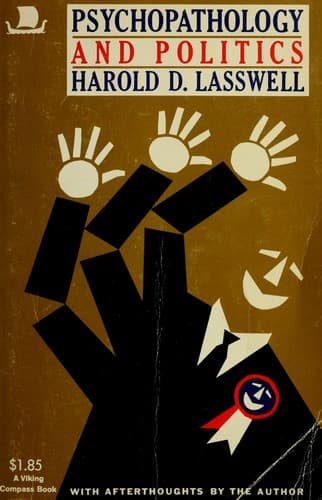
Psychopathology and politicsLasswell, Harold D. (Harold Dwight)
Science
Psychopathology and politics
Lasswell, Harold D. (Harold Dwight)
Personality and politics; Political science; Psychoanalysis; Psychology, Pathological
The value of some records is enhanced by the fact that, besides the
pathological productions of the patient, they contain much information
which is volunteered by the person when he is himself again. Some
forms of mental disorder show recurrent intervals of disturbance and
normality, and during the “clear” interludes the patient is quite
competent to furnish autobiographical data. Often the “remissions” in
the individual’s condition extend over several years, although they
may be momentary. Another form of mental disease is characterized by
the fact that the sufferer’s difficulties center about a single system
of ideas which, if left untouched by the interviewer, permits him to
be dealt with as an ordinary individual. It should be evident from
the foregoing that, contrary to popular impression, the histories to
be found in institutions for the care of the sick are by no means
exclusively confined to pathological subjects or to the merely
pathological aspects of the person.
Some of the life-histories which are summarized in this monograph come
from mental hospitals. Others have been collected from volunteers who
were outside mental institutions and who were aware of no serious
mental pathology. They have been undertaken on the understanding that
our knowledge of human nature in politics would be advanced if “normal”
individuals were studied with the same care which is often bestowed on
the abnormal.
So the book includes persons who are “sick” and persons who are “well.”
In the main the material is printed for the first time. There are no
retrospective interpretations of historical personages. The chief unity
of the study lies in the fact that it is restricted to politically
interesting people who have been studied while alive by specialists
under conditions of unusual intimacy.
The purpose of this venture is not to prove that politicians are
“insane.” Indeed, the specifically pathological is of secondary
importance to the central problem of exhibiting the developmental
profile of different types of public characters. Our job is not to
catalogue the symptoms at the expense of the main patterns of the
personality. We have not finished when we know that a modern Rousseau
suffered from paranoia; that a modern Napoleon has partly atrophied
genitalia; that modern Alexanders, Caesars, and Blüchers are alcoholic;
that a modern Calvin is plagued by eczema, migraine, and kidney stones;
that a modern Bismarck is hysterical; that a modern Lincoln shows
depressive pathology; that a modern Robespierre displays a eunuchoid
habitus; or that a modern Marat suffers from arthritis, diabetes, and
eczema. “Psychopathography” is legitimate and useful, but pathography
is not our aim.[3]
Public-domain text, read in full here on John Shaqi.
Reviews
Reviews
No reviews yet
Be the first to share your thoughts on this work.
Join the Discussion
Join the discussion
Sign in to leave a comment or review.
Sign InorCreate an account