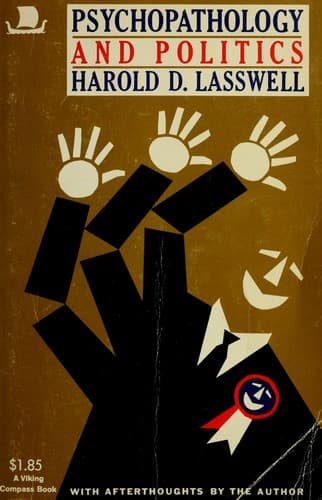
Psychopathology and politicsLasswell, Harold D. (Harold Dwight)
Science
Psychopathology and politics
Lasswell, Harold D. (Harold Dwight)
Personality and politics; Political science; Psychoanalysis; Psychology, Pathological
Nor is it the purpose of this book to make a hit-and-miss collection
of isolated anecdotes about the relation between early experiences
and specific political traits and interests. Not that this sort of
thing is not a liberalizing experience. Our conventional schemes of
“political motivation” seem curiously aloof from the manifold reality
of human life when we discover the private basis of public acts. John
B, to choose a random instance, is a busy, aggressive, and successful
salesman who spends a great deal of time and money on the care of the
blind. He takes time away from his business to serve on the board of
governors of institutions for the blind, and he handles many financial
campaigns on their behalf. Measures looking toward the improvement
of public or private care for these unfortunates are certain of
his support before legislative committees, on the platform, and in
personal conference. The study of his early memories finally revealed
the incident in which his ardent interest in the blind was rooted.
When he was between three and four years of age, his little sister
pulled an eye out of his favorite cat, and he was terribly distressed.
His concern for the safety of his pets was the original drive toward
protective work for the blind which matured into his adult activity.
It would be possible to fill many pages with reports of “critical
experiences” of this kind, and their importance is far greater than is
usually supposed.
If diagnostic labels and isolated anecdotes do not satisfy us, what do
we want? The answer can be succinctly stated thus: We want to discover
what developmental experiences are significant for the political traits
and interests of the mature. This means that we want to see what lies
behind agitators, administrators, theorists, and other types who play
on the public stage. Can we conceive the development of the human
personality as a functioning whole, and discern the turning-points
in the growth of various patterns of political life? Can we uncover
the typical subjective histories of typical public characters? Can we
place this subjective history in relation to the physical and cultural
factors which were developmentally significant?
Public-domain text, read in full here on John Shaqi.
Reviews
Reviews
No reviews yet
Be the first to share your thoughts on this work.
Join the Discussion
Join the discussion
Sign in to leave a comment or review.
Sign InorCreate an account