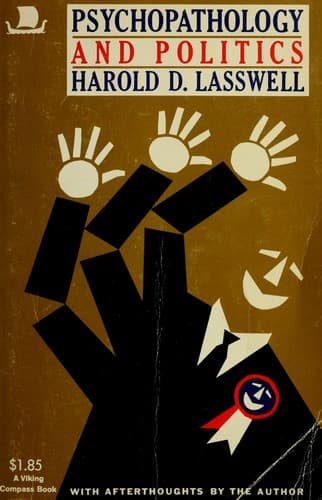
Psychopathology and politicsLasswell, Harold D. (Harold Dwight)
Science
Psychopathology and politics
Lasswell, Harold D. (Harold Dwight)
Personality and politics; Political science; Psychoanalysis; Psychology, Pathological
Distinctions within the agitating class itself may be drawn along
several lines. The oratorical agitator, in contradistinction to the
publicist, seems to show a long history of successful impostorship
in dealing with his environment. Mr. A, it will be recalled, was
able to pass for a model, and became skilled in the arts of putting
up a virtuous front. Agitators differ appreciably in the specificity
or the generality of the social objects upon which they succeed in
displacing their affects. Those who have been consciously attached to
their parents, and who have been successful impostors, are disposed to
choose remote and general objects. Those who have been conscious of
suppressing serious grievances against the early intimate circle, and
who have been unable to carry off the impostor’s rôle, are inclined to
pick more immediate and personal substitutes. The rational structure
tends toward theoretical completeness in the former case. Displacement
choices depend on the models available when the early identifications
are made. When the homosexual attitude is particularly important,
the assaultive, provocative relation to the environment is likely to
display itself; when the impotence fear is active, grandiose reaction
patterns appear more prominently.
CHAPTER VIII
POLITICAL ADMINISTRATORS
Some administrators are full of ideas and others are seldom attracted
by novelty. Some do their best work under a rather indulgent chief;
others fall to pieces unless there is strong pressure from above.
There are administrators who derive their influence over subordinates
from the authority of their positions rather than from the authority
of their personalities. There are some who may be depended upon for
the conscientious performance of detailed tasks, while others neglect
details and think in terms of general policy.
Viewed developmentally, it appears that one group of administrators is
remarkably akin to the agitators, differing only in the fact that they
are bound to particular individuals more closely, and thus displace
their affects upon less generalized objects. This gives a certain
independence to the administrator from the compulsion to “get a rise
out of” large numbers of the population. It ties him more securely,
however, to the members of his own environment, whose relations he
seeks to co-ordinate. The administrator is a co-ordinator of effort in
continuing activity.
The group which is allied to the agitators includes those who show
imagination and promoting drive. The history of H belongs in this
class, and has the incidental interest of showing how H behaved in war
time.
Public-domain text, read in full here on John Shaqi.
Reviews
Reviews
No reviews yet
Be the first to share your thoughts on this work.
Elsewhere in the archive
Join the Discussion
Join the discussion
Sign in to leave a comment or review.
Sign InorCreate an account