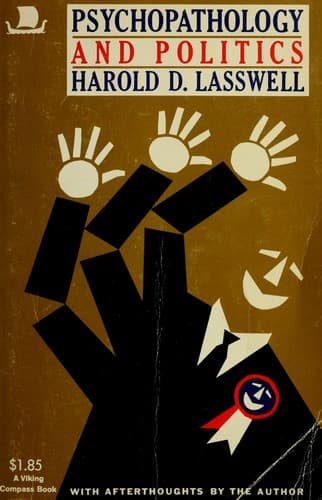
Psychopathology and politicsLasswell, Harold D. (Harold Dwight)
Science
Psychopathology and politics
Lasswell, Harold D. (Harold Dwight)
Personality and politics; Political science; Psychoanalysis; Psychology, Pathological
His career as an officer in the camp brought out the traits to which
reference has previously been made. His engaging deference toward
his superiors won them all, but he had trouble with the men. His own
insecurity led to an arrogant pose on his part that offended every
man in the company. He also discovered that the moment discipline was
relaxed he became very careless in performing his own duties.
The same constellation of traits reappeared in his administrative
career, modified by the fact that he learned to assume a less
provocative attitude toward his subordinates. He made a very good
record, and proposed a number of changes that were adopted for the
improvement of the service.
Looking back over H’s history, the striking thing is his prolonged
worry about his adjustment to specific persons. H was never able to
make the hurdle into abstract interests. Even his administrative ideas
were closely tied to the immediate context of the service. H’s life was
very much dominated by his relationship to definite people, and this
meant a prolonged carry-over of early attitudes to these individuals.
Unlike B, who could rightly feel that his father and brother and aunt
were treating him unjustly, H was all too aware that he “deserved” more
than he got. His success as an impostor was rudely interrupted in some
early episodes.
Another “marginal” history shows what happens to some men with
agitating aspirations who are not able to disentangle themselves
from a place inside an organization and to give themselves up wholly
to agitational work. Mr. I is a type occasionally met with inside
administrative staffs who makes a serious problem for himself and
others. He radiates plans that he neglects to execute, and he is
supercilious and defiant toward superiors. He lacks the drive, however,
to move over into agitational work entirely by identifying himself
with a sufficiently dramatic cause. Sometimes this is due, as in I’s
own case, to powerful early identifications with particular projects,
and with administrative work as such. When such a person can be pried
loose from certain of these early fixations, he often proves capable of
fulfilling the expectations which he is able to arouse.
Public-domain text, read in full here on John Shaqi.
Reviews
Reviews
No reviews yet
Be the first to share your thoughts on this work.
Elsewhere in the archive
Join the Discussion
Join the discussion
Sign in to leave a comment or review.
Sign InorCreate an account