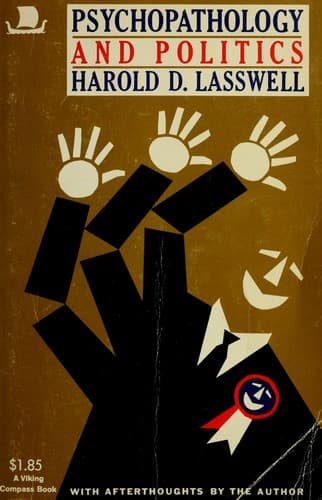
Psychopathology and politicsLasswell, Harold D. (Harold Dwight)
Science
Psychopathology and politics
Lasswell, Harold D. (Harold Dwight)
Personality and politics; Political science; Psychoanalysis; Psychology, Pathological
The father of I was a man whose extraordinary talents won him great
distinction, but who never quite managed to come through as brilliantly
as people had a right to expect from one so richly endowed. I’s father
could talk five or six languages and read many more. He was educated in
England, France, and Italy, and after serving as a professor of modern
languages, his interest in educational problems led him to become the
head of a famous preparatory school, and later of a public school. He
spent most of his time reading, and during the last decade of his life
drank heavily, but without impairing the quality of his work. Someone
who knew him pronounced the man “a self-centered intellectual who
died without a friend.” The mother of I was an adopted daughter of a
member of the British aristocracy, and was brought up in distinguished
social and intellectual circles. The mother was exceptionally active
in all sorts of humanitarian enterprises but lavished much time and
love on the boy, who was “dreadfully spoiled,” and accepted everybody’s
judgment that he was a budding genius.
True to anticipations, the boy shot through school like a meteor,
ranking first in his subjects, and taking every available honor with
ease. In college he branched out into social and political life on a
large scale, and joined about twenty organizations, managing to have
himself put on every important committee.
Like his father, the son took up public-school work. Becoming
interested in psychology, he did some graduate work, and quickly
published a book that received very favorable comment among those
best qualified to judge it. The idea of educational reform fired his
imagination, and he lectured far and wide, engaging in agitations to
secure legislation which would authorize a number of experimental
schools.
The part of his history which is especially interesting to the student
of administration is this: He was continually at outs with his
superiors and colleagues. His first teaching position began with a
feud, and lasted but a little while. He was invited to resign his next
post. He was asked to resign the next position. He was asked to resign
the next position. These entries appear monotonously through his record.
Everybody conceded the brilliance and fertility of his mind, and did
homage to the originality of his plans. He began work but failed to
carry it far, seeming to think that work planned was work done. His
methods were always aggressive. Seized of an administrative idea, he
went to his superiors. When they criticized the scheme, or rejected his
suggestion, he often took the bit in his teeth and tried to run the
ship in his own way.
Public-domain text, read in full here on John Shaqi.
Reviews
Reviews
No reviews yet
Be the first to share your thoughts on this work.
Elsewhere in the archive
Join the Discussion
Join the discussion
Sign in to leave a comment or review.
Sign InorCreate an account