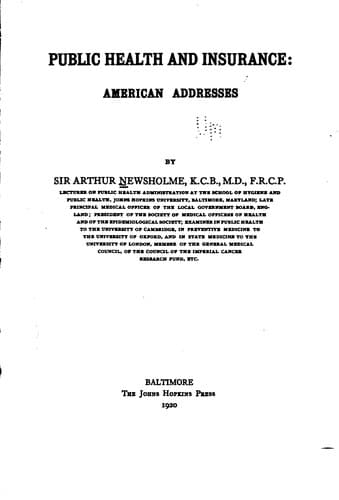
Public health and insurance: American addressesNewsholme, Arthur, Sir
History
Public health and insurance: American addresses
Newsholme, Arthur, Sir
Health insurance -- Great Britain; Public health; Public health -- Great Britain
4. Animal experimentation shows that in animals of the same
species the extent of tuberculosis produced depends to a large and
probably to a dominant extent on the number of tubercle bacilli
introduced into the system. Although doubtless there are variations
in susceptibility in families, and in each individual at different
periods, there is little doubt that in the main the same rule holds
good for mankind.
5. Experience shows that dusty occupations, indoor occupations,
alcoholism, over-fatigue, an attack of acute illness, especially of
influenza, measles, or enteric fever, increase the danger of minimal
doses of tubercle bacilli, and serve to bring latent foci of disease
into activity.
_Explanations of the Decreasing Death-rate from Tuberculosis_
In the light of the above facts, how is the steady and continuous
decline in the death-rate from tuberculosis during the last fifty
years to be explained?
(_a_) No support is given by animal experiment to the assumption
that the types of human bacillus infecting mankind have declined in
virulence; and changes in the severity of consumption historically
or currently in different races of mankind are equally explicable on
the ground of differences in social misery, in sanitary conditions
and associated heavier dosage of infection and neglect of treatment.
(_b_) The facts do not appear to me to be reconcilable with the
assumption that natural selection has increased human resistance
to infection by tuberculosis; though, were this so, it would
not justify refraining from every possible effort to control
infection and to treat every tuberculous patient by the best known
methods. Tuberculosis is an ancient disease, there being evidence
of it in Egyptian mummies 1000 years B.C.; and any selective
agency has, therefore, had ages for its operation. If the steady
decline—approximating 2 per cent. per annum in the death-rate from
pulmonary tuberculosis in England during the last thirty or forty
years—has resulted from the acquirement of racial immunity, it is
remarkable that a somewhat similar decline has occurred almost
simultaneously during the last forty years in Great Britain, Germany,
and America; while in France, Norway, and Ireland there has been
little if any decline, or it has occurred only in very recent years.
To assume that susceptibility to the tubercle bacillus in the course
of its natural history has diminished in England, and that Ireland
has not shared in this privilege would be to add one more to Irish
grievances! This assumption does not fit in with international
facts; which point rather to the conclusion that, during the period
in question, unsatisfactory sanitary and social circumstances,
including opportunities for massive and protracted infection, have
continued to a greater extent and for a longer time in Ireland and
France than in Great Britain, America and Germany.
Public-domain text, read in full here on John Shaqi.
Reviews
Reviews
No reviews yet
Be the first to share your thoughts on this work.
Elsewhere in the archive
Join the Discussion
Join the discussion
Sign in to leave a comment or review.
Sign InorCreate an account