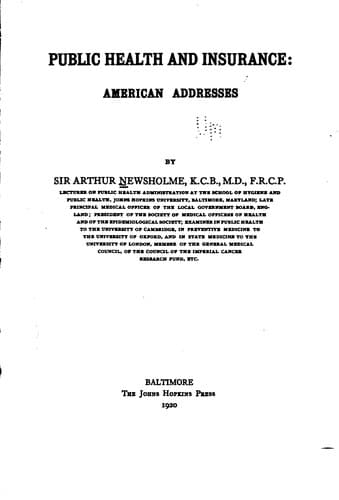
Public health and insurance: American addressesNewsholme, Arthur, Sir
History
Public health and insurance: American addresses
Newsholme, Arthur, Sir
Health insurance -- Great Britain; Public health; Public health -- Great Britain
I may, I think, claim to have answered in part the question asked
at an earlier stage of this address, as to the causes of the steady
decline in the death-rate from tuberculosis in recent decades. I do
not claim that any one factor has brought about this result. I do not
claim that it has been caused entirely by diminution of opportunities
of infection; but I deprecate the view that improved nutrition and
other conditions diminishing susceptibility have played a predominant
part. The facts of international hygienic history rebut this view.
Although segregation of patients in institutions has played a great
part in bringing about the result, diminution of domestic infection
as the result of more cleanly habits has doubtless had an important
influence; as has also the reduction of industrial dust.
It is significant that general hygiene and improved care of the
sick—quite apart from any intention to segregate—were associated
with a large reduction in the death-rate from tuberculosis before
the importance of reducing infection was fully appreciated; and that
since the necessity for direct measures against tuberculosis was
realised, since such measures have been begun, however imperfectly,
in many countries, and since anti-tuberculosis educational
propaganda has been somewhat active, there has been no increase
in the rapidity of decline of the death-toll of tuberculosis. Of
course, it cannot be seriously—though it is foolishly—argued from
this fact that such direct measures are futile. Every year there
has been increasing migration of masses of people into towns, with
a corresponding increase of undesirable domestic overcrowding
and of indoor occupations. If, therefore, such anti-tuberculosis
measures as have been adopted,—whether direct measures or general
sanitary measures,—had been associated with an absence of decline or
with actual increase in the death-rate from tuberculosis it might
still be that these measures have achieved much. Many conflicting
agencies are at work, and it might well be that the apparent lack
of success of the measures taken is due to the increased operation
of countervailing influences. The importance of direct action for
the control of tuberculosis must be judged not solely by necessarily
imperfect statistical measurement on the basis of a few years’
observation, but _by ascertaining that the proposed measures are in
accord with our knowledge of the natural history of the disease_. As
we have seen, both comparative and human pathology assure us that
tuberculosis is a communicable and therefore a preventible disease,
and point the way to the means for securing this end.
Public-domain text, read in full here on John Shaqi.
Reviews
Reviews
No reviews yet
Be the first to share your thoughts on this work.
Elsewhere in the archive
Join the Discussion
Join the discussion
Sign in to leave a comment or review.
Sign InorCreate an account