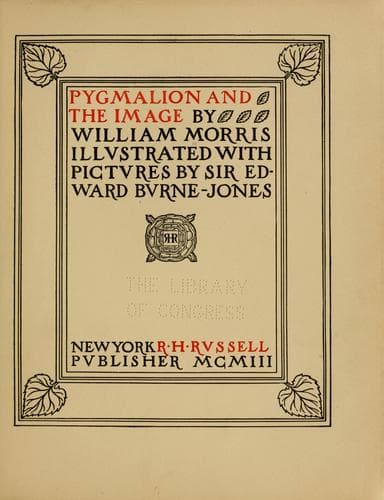
English poetry -- 19th century; Pygmalion (Greek mythology) -- Poetry
arms on one uplifted from the goddess's side, an exquisite piece of
composition, the awakening image stoops from the carved capital,
blossom-strewn by the adoring Pygmalion, her eyes raised in awe up to
the goddess, who with fixed gaze and pointed finger inspires her with
the Promethean fire of life. Lastly, 'The Soul Attains.' Heart and soul
are alike satisfied. Pygmalion kneels, looking up in trembling worship
at the beautiful creature who lingeringly yields him her hands, though
she still gazes out beyond him in dumb amazement at the mystery of
consciousness that has suddenly been born in her. Marble no longer, but
not yet altogether woman."
"Dreamer of dreams, born out of my due time," is even more appropriate
to Burne-Jones than to its author, William Morris, and it is an
ever-to-be-regretted misfortune that two poems only of those comprised
in _The Earthly Paradise_ should have received at his hands that
illuminative pictorial treatment which he, "the arch-dreamer of the
nineteenth century," as Cosmo Monkhouse styles him, alone could
give. Thanks to Mr. Frederick Hollyer, we have in the reproductions
which follow faithful transcripts, in all but color, of the original
paintings, and can carry out, after the lapse of a quarter of a century
and in another hemisphere, a project which both Burne-Jones and William
Morris held dear, but which neither of them lived to see realized. To
their memory this book, together with the recently re-issued _Doom of
King Acrisius_, is dedicated.
FITZROY CARRINGTON.
ORIENTA COTTAGE,
MAMARONECK, NEW YORK,
DECEMBER ELEVENTH, 1902
[Illustration: A] MAN OF CYPRUS, A SCULPTOR NAMED PYGMALION, MADE
AN IMAGE OF A WOMAN, FAIRER THAN ANY THAT HAD YET BEEN SEEN, AND IN
THE END CAME TO LOVE HIS OWN HANDIWORK AS THOUGH IT HAD BEEN ALIVE:
WHEREFORE, PRAYING TO VENUS FOR HELP, HE OBTAINED HIS END, FOR SHE MADE
THE IMAGE ALIVE INDEED, AND A WOMAN, AND PYGMALION WEDDED HER.
_WILLIAM MORRIS_
[Illustration: A]t Amathus, that from the southern side
Of Cyprus looks across the Syrian sea,
There did in ancient time a man abide
Known to the island-dwellers, for that he
Had wrought most godlike works in imagery,
And day by day still greater honor won,
Which man our old books call Pygmalion.
Yet in the praise of men small joy he had,
But walked abroad with downcast, brooding face.
Nor yet by any damsel was made glad;
For, sooth to say, the women of that place
Must seem to all men an accursed race,
Who with the turner of all hearts once strove,
So in their hearts must carry lust for love.
Now on a day it chanced that he had been
About the streets, and on the crowded quays,
Rich with unopened wealth of bales, had seen
The dark-eyed merchants of the Southern seas
In chaffer with the base Propoetides,
And heavy-hearted gat him home again,
His once-loved life grown idle, poor, and vain.
Public-domain text, read in full here on John Shaqi.
Reviews
Reviews
No reviews yet
Be the first to share your thoughts on this work.
Join the Discussion
Join the discussion
Sign in to leave a comment or review.
Sign InorCreate an account