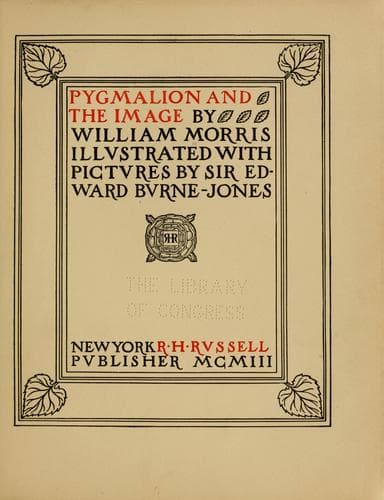
English poetry -- 19th century; Pygmalion (Greek mythology) -- Poetry
And there upon his images he cast
His weary eyes, yet little noted them,
As still from name to name his swift thought passed,
For what to him was Juno's well-wrought hem,
Diana's shaft, or Pallas' olive-stem?
What help could Hermes' rod unto him give,
Until with shadowy things he came to live?
Yet note, that though, while looking on the sun,
The craftsman o'er his work some morn of spring
May chide his useless labor never done,
For all his murmurs, with no other thing
He soothes his heart, and dulls thought's poisonous sting,
And thus in thought's despite the world goes on;
And so it was with this Pygmalion.
Unto the chisel must he set his hand,
And slowly, still in troubled thought must pace
About a work begun, that there doth stand,
And still returning to the self-same place,
Unto the image now must set his face,
And with a sigh his wonted toil begin,
Half loathed, half loved, a little rest to win.
The lessening marble that he worked upon,
A woman's form now imaged doubtfully,
And in such guise the work had he begun,
Because when he the untouched block did see
In wandering veins that form there seemed to be,
Whereon he cried out in a careless mood,
"O lady Venus, make this presage good!
"And then this block of stone shall be thy maid,
And, not without rich golden ornament,
Shall bide within thy quivering myrtle-shade."
So spoke he, but the goddess, well content,
Unto his hand such godlike mastery sent,
That like the first artificer he wrought,
Who made the gift that woe to all men brought.
And yet, but such as he was wont to do,
At first indeed that work divine he deemed,
And as the white chips from the chisel flew
Of other matters languidly he dreamed,
For easy to his hand that labor seemed,
And he was stirred with many a troubling thought,
And many a doubt perplexed him as he wrought.
And yet, again, at last there came a day
When smoother and more shapely grew the stone,
And he, grown eager, put all thought away
But that which touched his craftsmanship alone;
And he would gaze at what his hands had done,
Until his heart with boundless joy would swell
That all was wrought so wonderfully well.
Yet long it was ere he was satisfied,
And with his pride that by his mastery
This thing was done, whose equal far and wide
In no town of the world a man could see,
Came burning longing that the work should be
E'en better still, and to his heart there came
A strange and strong desire he could not name.
The night seemed long, and long the twilight seemed,
A vain thing seemed his flowery garden fair;
Though through the night still of his work he dreamed,
And though his smooth-stemmed trees so nigh it were
That thence he could behold the marble hair,
Naught was enough, until with steel in hand
He came before the wondrous stone to stand.
Public-domain text, read in full here on John Shaqi.
Reviews
Reviews
No reviews yet
Be the first to share your thoughts on this work.
Join the Discussion
Join the discussion
Sign in to leave a comment or review.
Sign InorCreate an account