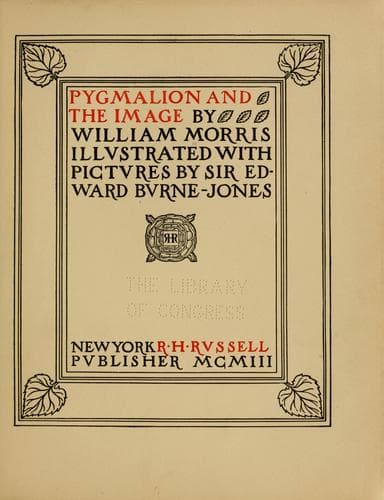
English poetry -- 19th century; Pygmalion (Greek mythology) -- Poetry
No song could charm him, and no histories
Of men's misdoings could avail him now--
Nay, scarcely seaward had he turned his eyes
If men had said, "The fierce Tyrrhenians row
Up through the bay; rise up and strike a blow
For life and goods"; for naught to him seemed dear
But to his well-loved work to be anear.
Then vexed he grew, and, knowing not his heart,
Unto himself he said, "Ah, what is this
That I who oft was happy to depart
And wander where the boughs each other kiss
'Neath the west wind, now have no other bliss
But in vain smoothing of this marble maid,
Whose chips this month a drachma had outweighed?
"Lo! I will get me to the woods and try
If I my woodcraft have forgotten quite,
And then, returning, lay this folly by,
And eat my fill, and sleep my sleep anight,
And 'gin to carve a Hercules aright
Upon the morrow, and perchance indeed
The Theban will be good to me at need."
With that he took his quiver and his bow,
And through the gates of Amathus he went,
And towards the mountain slopes began to go,
Within the woods to work out his intent.
Fair was the day, the honied bean-field's scent
The west wind bore unto him; o'er the way
The glittering, noisy poplar leaves did play.
All things were moving; as his hurried feet
Passed by, within the flowery swath he heard
The sweeping of the scythe, the swallow fleet
Rose over him, the sitting partridge stirred
On the field's edge; the brown bee by him whirred,
Or murmured in the clover flowers below;
But he with bowed-down head failed not to go.
At last he stopped, and, looking round, he said,
"Like one whose thirtieth year is well gone by,
The day is getting ready to be dead;
No rest, and on the border of the sky
Already the great banks of dark haze lie;
No rest--what do I midst this stir and noise?--
What part have I in these unthinking joys?"
With that he turned, and towards the city gate
Through the sweet fields went swifter than he came,
And cast his heart into the hands of fate;
Nor strove with it, when higher 'gan to flame
That strange and strong desire without a name;
Till panting, thinking of naught else, once more
His hand was on the latch of his own door.
One moment there he lingered, as he said,
"Alas! what should I do if she were gone?"
But even with that word his brow waxed red
To hear his own lips name a thing of stone,
As though the gods some marvel there had done,
And made his work alive; and therewithal,
In turn, great pallor on his face did fall.
But with a sigh he passed into the house;
Yet even then his chamber door must hold,
And listen there, half blind and timorous,
Until his heart should wax a little bold;
Then, entering, motionless and white and cold,
He saw the image stand amidst the floor
That whitened was by labor done before.
_The Heart Desires_
[Illustration]
Public-domain text, read in full here on John Shaqi.
Reviews
Reviews
No reviews yet
Be the first to share your thoughts on this work.
Join the Discussion
Join the discussion
Sign in to leave a comment or review.
Sign InorCreate an account