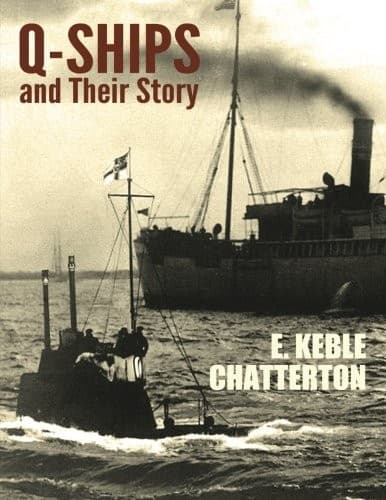
Q-Ships and Their StoryChatterton, E. Keble (Edward Keble)
History
Q-Ships and Their Story
Chatterton, E. Keble (Edward Keble)
Q-ships; World War, 1914-1918 -- Naval operations
On July 2 _Gaelic_ had another indecisive duel, and on the tenth _Glen_
(now commanded by Sub-Lieutenant K. Morris, R.N.R.) once more was in
action. This time she was further down Channel, about 45 miles S.W. of
Portland Bill. In this incident the enemy fired several rifle-shots
at the panic party rowing in the boat. An officer appeared at the
conning-tower presently, hailed this rowing boat, and in good English
ordered her to come alongside. The boat began to do so, but just then
something seemed suddenly to startle the officer, and he disappeared
into the conning-tower. _Glen_ opened fire, and the submarine—one of
the UC type—submerged. She was not sunk, but she had been damaged, and
Sub-Lieutenant Morris was awarded the D.S.C.
We saw just now that submarines were very fond of hanging about on
the approach to Cherbourg. There was a sound reason for this. The
coal-fields of France were in the hands of the enemy, consequently
it fell to us to keep France supplied. From February, 1917, a system
was organized which was the real beginning of the convoy method soon
afterwards adopted with such beneficial results to our shipping. This
embryonic organization was known as the ‘F.C.T.’—French Coal-Trade
Traffic. The ships would load coal up the Bristol Channel and then
sail independently round to Weymouth Bay. Having thus collected, they
were sailed across to Cherbourg together in a group, protection being
afforded by trawlers during daylight and moonlight hours only. As one
looked at this heterogeneous collection of craft, some of them of great
age, lying at anchor off Weymouth Harbour, they seemed distinctly a
curious lot; but there was a great dearth of shipping at that time, and
any old vessel that could carry coal and go ahead was worth her weight
in gold. The system was found most successful, and other group sailings
on definite routes, such as Falmouth-Brest and Dover-Dunkirk, were
instituted.
The next development was to have one or two Q-ships among the convoys,
for the most obvious of reasons, and especially well astern of the
convoy, so that the enemy might take them for stragglers and sink them
before any of the escort could turn back and help. Then came a still
further development, which had been in the minds of many naval officers
for a long time. Since there was such a scarcity of tonnage available
for general purposes, why not let the Q-ship, instead of carrying
ballast, be loaded with a proper cargo? She could easily carry this
without interfering with her fighting ability: in fact, she would be
trimmed more normally, and rather increase than decrease her power of
deception. As to the possibility of secrecy being lost whilst loading
in port, the armament was very cleverly concealed and only a little
organization was necessary to prevent her true character being bruited
about. The main difficulty would be when in the presence of neutral
shipping in that particular harbour, but this problem was capable of
solution.
Public-domain text, read in full here on John Shaqi.
Reviews
Reviews
No reviews yet
Be the first to share your thoughts on this work.
Elsewhere in the archive
Join the Discussion
Join the discussion
Sign in to leave a comment or review.
Sign InorCreate an account