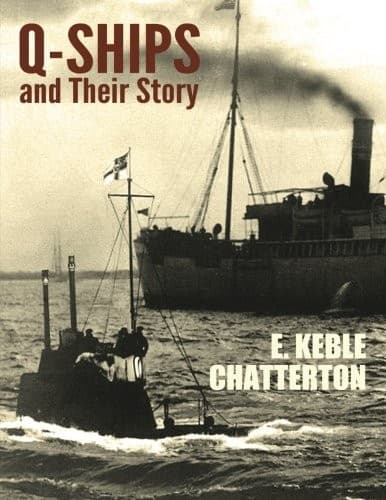
Q-Ships and Their StoryChatterton, E. Keble (Edward Keble)
History
Q-Ships and Their Story
Chatterton, E. Keble (Edward Keble)
Q-ships; World War, 1914-1918 -- Naval operations
Thus it happened now that in many cases the Q-ship became also a
trader. Be it noted, her character was not that of an armed merchant
ship which is armed only defensively, but a properly commissioned
warship carrying cargo as well as her offensive armament. Now, one of
these craft was the two-masted 179-ton brigantine _Probus_ (alias Q 30,
_Ready_, _Thirza_, _Elixir_). She had been purchased by the Admiralty
in 1915, and fitted with an auxiliary motor. Then, based on Granton,
she had worked as a decoy in the North Sea.
In May, 1917, having done excellent work as a pure decoy, we find her
as a decoy-trader. Having loaded up with coal at Granton, she left
there on May 4, and duly arrived at Treguier. From there she proceeded
to Swansea with a cargo of pit-props, which were much needed by the
Welsh coal mines, seeing that our customary supply from Scandinavia,
via the North Sea, was so endangered at that time. From Swansea
_Probus_, who was armed with two 12-pounders and two 6-pounders, sailed
round to Falmouth, and at 3.30 on the afternoon of June 20 she set sail
for Morlaix in company with twelve sailing ships and the one steamship
escort, the armed trawler _Harlech Castle_. Think of it in these modern
days: a dozen sailing vessels coming out past St. Anthony’s Lighthouse!
Truly this war has shown how history goes on repeating itself. Who
would have thought that sailing-ship convoys, which in other wars used
to assemble and leave Falmouth, would ever be witnessed again?
Now, to control a dozen sail you must have sea-room, so the convoy
was arranged thus: A mile ahead of the first sailing ship steamed the
trawler, then came the twelve ships spread over 3 miles, and then 4
miles astern of the last ship, and looking just as a straggler would
be, sailed the _Probus_. There was thus a distance of 8 miles between
her and the escort trawler. Most of a day passed before anything
occurred. At 2.15 p.m. on June 21 _Probus_, still astern of the convoy,
was about 23 miles south-west of the Start and heading on a course S.E.
by S. The wind was S.W., force 3, and she was doing about 4 knots
through the water, when she observed what appeared to be a ketch-rigged
vessel, steering the same course, 4 miles away on the starboard
quarter; but from the rapidity with which the bearing altered, it was
soon obvious that the ketch was not under sail alone. At 2.30 p.m.
the ‘ketch’ proved her submarine identity by opening fire, the first
shot falling 10 yards clear of the brigantine’s beam. _Probus_ then
hove-to, the crew went to action stations, and the boat was got ready
to be launched, while the submarine kept up a rapid fire from about
4,000 yards, shells falling unpleasantly close. By now _Probus_ was
heading about S.W. with fore-yards aback, and, owing to the light
wind, was making a stern board. Then her head fell round slowly to the
west. The enemy was now bearing about W. to W.S.W., firing rapidly,
Public-domain text, read in full here on John Shaqi.
Reviews
Reviews
No reviews yet
Be the first to share your thoughts on this work.
Elsewhere in the archive
Join the Discussion
Join the discussion
Sign in to leave a comment or review.
Sign InorCreate an account