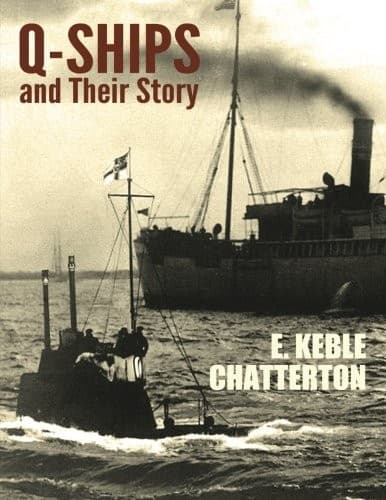
Q-Ships and Their StoryChatterton, E. Keble (Edward Keble)
History
Q-Ships and Their Story
Chatterton, E. Keble (Edward Keble)
Q-ships; World War, 1914-1918 -- Naval operations
and heading to the south-east so as to cross the brigantine’s bows.
It was a beautifully clear summer’s afternoon, and you could see the
convoy and the smoke from the escorting trawler quite easily. After the
submarine had maintained a continuous long-range fire for ten minutes,
_Probus_ ran up the White Ensign, and at 3,500 yards opened fire with
her starboard 12-pounder. The first round fell 500 yards short, but the
crew of the submarine’s gun hurriedly left their station and made for
the conning-tower. The second shot seemed to be a hit, for the enemy,
lying across the brigantine’s bows, stopped, and a large cloud of smoke
went up, and he temporarily ceased fire.
_Probus_ then went about on the other tack, and the enemy took
advantage of this to resume firing, while shots began to fall all
round; but the port 12-pounder of the British ship now came into
action, and the fourth shot was certainly another hit, for it
dismantled the German’s sails and mast, and raised a cloud of smoke
from the fore part of the conning-tower. Shelling continued, and the
enemy was compelled to submerge, _Probus’s_ parting shot hitting him
on the top of the conning-tower. It was now about 3.30 p.m., and
nothing was seen of the German until a quarter of an hour later, when
he was sighted 6 miles away approaching _Probus_. He had probably been
stopping his shell-holes, and was now ready to give the sailing ship
the knock-out blow; but the armed trawler, with its fishermen crew
eager to have a hand in the fight, was by this time making towards the
submarine, and this compelled the German to break off the engagement
and scurry to the north-east.
Unfortunately this duel demonstrated yet again the great weakness
of the sailing ship as a man-of-war. In the olden days, when the
swift-moving galley fought the sailing carrack or caravel, the galley
was able to press home her attack if the weather fell light, and left
the other ship rolling helpless in the calm, with yards and tackle
grievously creaking and chafing. The submarine is the modern galley,
and the Q-sailing-ship is the carrack’s counterpart. As long as there
was a good breeze she could be manœuvred, and if there was a hard
breeze it would make it difficult for the enemy’s gunnery. _Probus_
was practically becalmed, so the submarine could run rings round her,
and the sailing ship could not be worked up to windward. Of course,
on these and similar occasions troubles seldom come singly; for when
the brigantine _Probus_ made a stern board her starboard propeller
had fouled the log-line, so this was out of action. However, _Probus_
resumed her original course, followed the convoy, and in spite of the
light airs duly arrived at Morlaix on June 25.
[Illustration: Q-SAILING SHIP “FRESH HOPE”
This was a 900-ton three-masted schooner which was requisitioned in the
last year of the war. She had previously been the United States “Edith
E. Cummins.”]
[Illustration: Q-SHIP “RECORD REIGN”
Public-domain text, read in full here on John Shaqi.
Reviews
Reviews
No reviews yet
Be the first to share your thoughts on this work.
Elsewhere in the archive
Join the Discussion
Join the discussion
Sign in to leave a comment or review.
Sign InorCreate an account