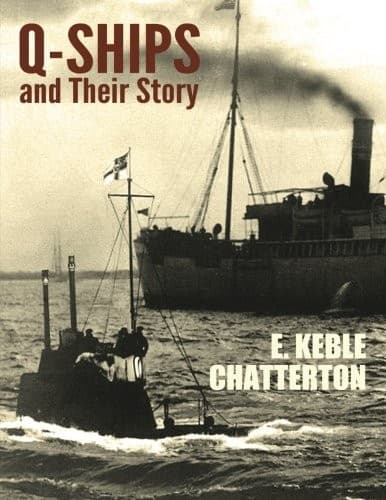
Q-Ships and Their StoryChatterton, E. Keble (Edward Keble)
History
Q-Ships and Their Story
Chatterton, E. Keble (Edward Keble)
Q-ships; World War, 1914-1918 -- Naval operations
If you will examine the photos of Commander Douglas’s Q-ship
_Barranca_, you will see how cleverly, by means of a little faking,
even a much bigger ship could be disguised. In one picture you see
her alley-ways covered up by a screen, funnel markings altered, and
so on; whilst in another the conspicuous white upper-works, the white
band on the funnel, and the dark hull make her a different ship, so
that, he tells me, on one occasion after passing a suspicious neutral
steamer and not being quite satisfied, he was able to steam out of
sight, change his ship’s appearance, and then overtake her, get quite
close and make a careful examination without revealing his identity.
To the landsman all this may seem impossible, but inasmuch as the
sea is traversed nowadays by steamers differing merely in minute
details, distinguished only to the practised eye of the sailor, such
deception is possible. I remember on one occasion during the war a
surprising instance of this. Being in command of a steam drifter off
the south-west Irish coast, I obtained Admiral Bayly’s permission at
my next refit to have the ship painted green, the foremast stepped,
the funnel and markings painted differently, and a Dublin fishing
letter and number painted on the bows, a suitable name being found in
the Fisherman’s Almanack. The 6-pounder gun forward was covered with
fishing gear, which could be thrown overboard as soon as the ship
came into action. Discarding naval uniform and wearing old cloth caps
and clothes, we left Queenstown, steamed into Berehaven, and tied up
alongside a patrol trawler with whom we had been working in company for
nearly a year. The latter’s crew never recognized us until they saw our
faces, and even then insisted that we had got a new ship! In fact, one
of them asserted that he knew this Dublin drifter very well, at which
my Scotch crew from the Moray Firth were vastly amused.
[Illustration: Q-SHIP “BARRANCA”
Disguised as a different ship with yellow funnel and black boot-top.]
[Illustration: Q SHIP “BARRANCA”
Appearance changed by closing up alley-ways, painting hull, ship’s
boats, and funnel so as to resemble a freighter of the P. & O. Line.
To face p. 222]
Routine at sea of course differed in various Q-ships, but it may
be interesting to set down the following, which prevailed in that
well-organized ship _Penshurst_:
SEA ROUTINE.
Time as { Call guns’ crew of morning watch; 3-pounder crew
per Night { lash up and stow. Guns’ crew close up, uncover
Order { guns, unship 6-pounder night-sights. Gunlayers
Book. { report their crews closed up to officers of the
{ watch.
5.30 a.m. Call cooks and stewards.
6.0 a.m. 12-pounder crew and one of 3-pounder crew to wash
down bridges and saloon-decks.
7.0 a.m. Call guns’ crews of forenoon watch, lash up and
stow hammocks. Hands to wash.
7.30 a.m. Forenoon watch to breakfast.
Public-domain text, read in full here on John Shaqi.
Reviews
Reviews
No reviews yet
Be the first to share your thoughts on this work.
Elsewhere in the archive
Join the Discussion
Join the discussion
Sign in to leave a comment or review.
Sign InorCreate an account