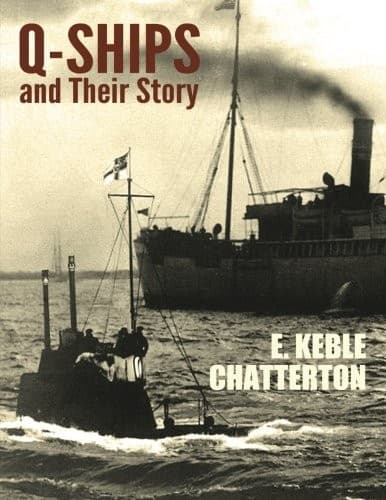
Q-Ships and Their StoryChatterton, E. Keble (Edward Keble)
History
Q-Ships and Their Story
Chatterton, E. Keble (Edward Keble)
Q-ships; World War, 1914-1918 -- Naval operations
8.0 a.m. Change watches. Morning watch lash up and stow
hammocks. Breakfast.
9.0 a.m. Watch below clean mess-deck, etc.
11.30 a.m. Afternoon watch to dinner.
12.30 p.m. Change watches. Forenoon watch to dinner.
1.30 p.m. Cooks clean up mess-deck.
3.30 p.m. Tea.
4.0 p.m. Change watches. Afternoon watch to tea.
6.0 p.m. Change watches.
7.0 p.m. Supper.
8.0 p.m. Change watches. Watch below to supper.
Sunset. Clean guns, ship 6-pounder night-sights. Cover
guns. Drill as required.
A few weeks after the war, Lord Jellicoe remarked publicly that in
the ‘mystery ship’ there had been displayed a spirit of endurance,
discipline, and courage, the like of which the world had never seen
before. He added that he did not think the English people realized the
wonderful work which these ships had done in the war. No one who reads
the facts here presented can fail to agree with this statement, which,
indeed, is beyond argument. Discipline, of course, there was, even in
the apparently and externally most slovenly tramp Q-ship; and it must
not be thought that among so many crews of ‘hard cases’ all the hands
were as harmless as china shepherdesses. When ashore, the average
sailor is not always at his best: his qualities are manifest on sea and
in the worst perils pertaining to the sea. The landsman, therefore,
has the opportunity of observing him when the sailor wants to forget
about ships and seas. If some of the Q-ships’ crews occasionally kicked
over the traces in the early days the fault was partly their own, but
partly it was as the result of circumstances. Even Q-ship crews were
human, and after weeks of cruising and pent-up keenness, after being
battered about by seas, shelled by submarines while lying in dreadful
suspense, and then doing all that human nature could be expected to
perform, much may be forgiven them if the attractions of the shore
temporarily overpowered them. In the early stages of the Q-ship the
mistake was made of sending to them the ‘bad hats’ and impossible men
of the depots; but the foolishness of this was soon discovered. Only
the best men were good enough for this special service, and as the men
were well paid and well decorated in return for success, there was no
difficulty in choosing from the forthcoming volunteers an ideal crew.
Any Q-ship captain will bear testimony to the wonderful effect wrought
on a crew by the first encounter with an enemy submarine. The average
seaman has much in him of the simple child, and has to be taught by
plain experience to see the use and necessity of monotonous routine,
of drills and discipline; but having once observed in hard battle the
value of obedience, of organization and the like, he is a different
man—he looks at sea-life, in spite of its boredom, from a totally
different angle. Perfect discipline usually spelled victory over the
enemy. Presently that, in turn, indicated a medal ribbon and ‘a drop
Public-domain text, read in full here on John Shaqi.
Reviews
Reviews
No reviews yet
Be the first to share your thoughts on this work.
Elsewhere in the archive
Join the Discussion
Join the discussion
Sign in to leave a comment or review.
Sign InorCreate an account