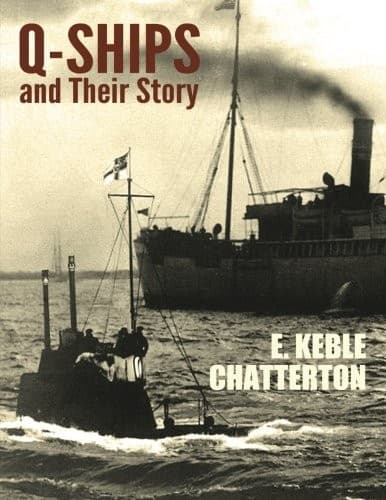
Q-Ships and Their StoryChatterton, E. Keble (Edward Keble)
History
Q-Ships and Their Story
Chatterton, E. Keble (Edward Keble)
Q-ships; World War, 1914-1918 -- Naval operations
But on this night his Q-ship career came to a sudden stop, though not
before everything possible had been done to entrap the enemy. It was
one of those cloudy, moonlight, wintry nights with good visibility.
As might have been expected under such a captain there was a total
absence of confusion; all hands went to their stations, the ‘panic’
party got away in accordance with the best ‘panic’ traditions, while
on board the crews remained at their gun stations for five hours,
hoping and longing for the submarine to show herself. No such good
fortune followed, for the submarine was shy; so just before midnight
Commander Hanrahan sent a wireless message to Admiral Bayly at
Queenstown, and very shortly afterwards the U.S. destroyer _Cummings_
arrived. At 1 a.m. the tug _Paladin_ took _Santee_ in tow, escorted by
four United States destroyers and the two British sloops _Viola_ and
_Bluebell_. _Santee_ got safely into port and was sent to Devonport,
where she was eventually handed back by the U.S.N. to the British
Navy, owing to the time involved in repairs. On June 4, 1918, she
was once more recommissioned in the Royal Navy and took the name of
_Bendish_, the crew having come from the Q-ship _Starmount_. By this
date the conditions of submarine warfare had undergone a modification.
In home waters it was only the quite small Q-ships of the coaster
type, of about 500 tons, which could be expected to have any chance
of successfully engaging a submarine. This class would normally be
expected to be seen within the narrow seas, and the enemy would not
be so shy. But for such vessels as _Bendish_ and _Pargust_ the most
promising sphere was likely to be between Gibraltar and the Azores
and the north-west coast of Africa, where German so-called ‘cruiser’
submarines of the _Deutschland_ type were operating. Therefore a
special force, based on Gibraltar but operating in the Azores area or
wherever submarines were to be expected, was organized, consisting
of four Q-ships. These were the _Bendish_ (late _Santee_), Captain
Campbell’s former ship _Pargust_ but now named the _Pangloss_, the
_Underwing_, and the _Marshfort_, the whole squadron being under
the command of Lieut.-Commander Dane in _Bendish_. After being at
last ready for sea in May, 1918, _Pangloss_, commanded by Lieutenant
Jeffrey, who for his fine work in _Chagford_ had received the D.S.O.,
had then been assigned to serve under the Vice-Admiral Northern Patrols
until she was sent south.
[Illustration: Q-SHIP TRANSFORMATION
Crew painting funnel while at sea (see pp. 220-1).]
[Illustration: Q-SHIP “BARRANCA” AT SEA
The look-out man aft is disguised as one of the Mercantile crew. The
dummy wheel, dummy sky-light, and dummy deck-house are seen. The latter
concealed a 4-inch gun and two 12-pounders.
To face p. 234]
Public-domain text, read in full here on John Shaqi.
Reviews
Reviews
No reviews yet
Be the first to share your thoughts on this work.
Elsewhere in the archive
Join the Discussion
Join the discussion
Sign in to leave a comment or review.
Sign InorCreate an account