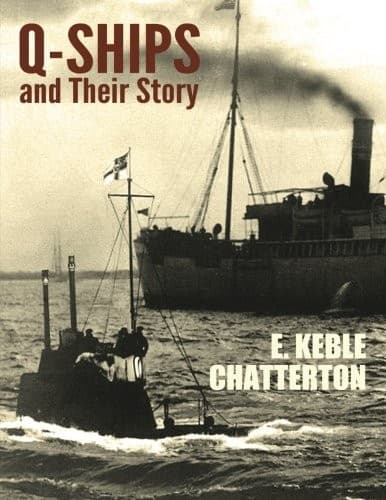
Q-Ships and Their StoryChatterton, E. Keble (Edward Keble)
History
Q-Ships and Their Story
Chatterton, E. Keble (Edward Keble)
Q-ships; World War, 1914-1918 -- Naval operations
_Suffolk Coast_ was intentionally the most ordinary-looking little
coaster, with three masts, her engines and funnel being placed aft, and
the very last thing she resembled was a man-of-war. But she was heavily
armed for so small a ship. In her were embodied all the concentrated
experience of battle and engineering development. All that could be
learned from actual fighting, from narrow escapes, and from defects
manifested in awkward moments was here taken advantage of. Instead of
a 12-knot 4,000-ton steamer the development had, owing to the trend of
the campaign, been in the direction of a ship one-eighth of the size,
but more cleverly disguised with better ‘gadgets.’ In fact, instead of
being a model of simplicity as in the early days, the Q-ship had become
a veritable box of tricks. It was the triumph of mind over material, of
brain over battle. Coolness and bravery and resolute endurance were
just as requisite in the last as in the first stages of the campaign,
but the qualities of scientific bluff had attained the highest value.
The basic principle was extreme offensive power combined with outward
innocence: the artfulness of the eagle, but the appearance of a dove.
In _Suffolk Coast_ there was one long series of illusions from forward
to aft. On the fo’c’sle head was a quite usual wire reel such as is
used in this class of ship for winding in a wire rope. But this reel
had been hollowed out inside so as to allow the captain to con the
ship. Near by was also a periscope, but this was disguised by being
hidden in a stove-pipe such as would seem to connect with the crew’s
heating arrangements below. Now this was not merely a display of
ingenuity but an improvement based on many a hard case. What frequently
happened after the ‘abandon ship’ party pushed off? As we have seen,
this was often the time when the real fight began, and the enemy would
shell the bridge to make sure no living thing could remain. That
being so, the obvious position for the captain was to be away from
the bridge, though it broke away from all the traditions of the sea.
In _Suffolk Coast_ the enemy could continue sweeping the bridge, but
the captain would be under the shelter of the fo’c’sle head and yet
watching intently. Similarly both he and his men need not, in passing
from the bridge or one end of the ship to another, be exposed to the
enemy’s fire, for an ingenious tunnel was made right into the fo’c’sle
through the hold. In a similar manner, if the forward part of the ship
had been ‘done in,’ there was a periscope aft disguised as a pipe
coming up from the galley stove.
Public-domain text, read in full here on John Shaqi.
Reviews
Reviews
No reviews yet
Be the first to share your thoughts on this work.
Elsewhere in the archive
Join the Discussion
Join the discussion
Sign in to leave a comment or review.
Sign InorCreate an account