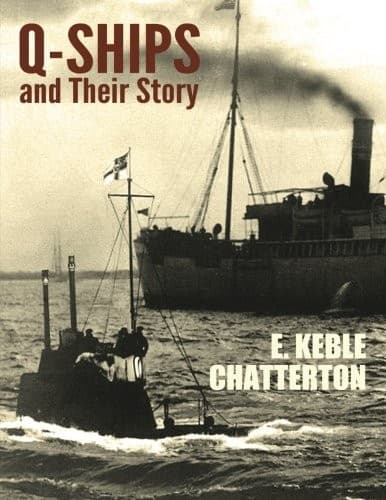
Q-Ships and Their StoryChatterton, E. Keble (Edward Keble)
History
Q-Ships and Their Story
Chatterton, E. Keble (Edward Keble)
Q-ships; World War, 1914-1918 -- Naval operations
Having received orders to proceed, Lieutenant Muhlhauser then began to
take the _Dusseldorf_ across the North Sea. I am indebted to him for
having allowed me to see his private diary of this voyage, and I think
it well illustrates the unexpected and surprising difficulties with
which Q-ship officers so frequently found themselves confronted. Having
parted company with the _Tay and Tyne_, _Dusseldorf’s_ new captain
proceeded to look for navigational facilities, but in this respect she
was amazingly ill-found. The only chart available showed just a small
portion of the North Sea, and there was no sextant in the ship. This
was a delightful predicament, for with all her magnetic ore it could
be taken for certain that the compass would have serious deviation,
and, having regard to the number of minefields in the North Sea and the
physical dangers of the east coast of Scotland, it was a gloomy prelude
to crossing from one side to the other.
Having been round the ship, it was now possible to ascertain her
character. She was not a thing of beauty, there was no electric light,
the engine-room was in a neglected condition, and round it were the
engineers’ cabins, the skipper and mate being berthed in a deckhouse
under the bridge. However, as the prize dipped to the North Sea swell
it was a joy to realize that all the hundreds of tons of ore would
not reach Germany. At this late stage of the war she was very short
of this commodity, and the loss to her would be felt. The _Tay and
Tyne_ had certainly made a most useful capture. Fortunately there was
found plenty of food in _Dusseldorf_, and enough coal for about three
weeks, so if only a few days’ fine, clear weather could be ensured,
the ship would soon be across and anchored in a British harbour. That,
of course, was always supposing there was no encountering of mines or
torpedoes.
By dusk of the first day the Halten Lighthouse (Lat. 64.10 N., Long.
9.25 E.) was made out, and then the night set in. For some time the
glass had been falling, and before the morning it was blowing a gale
of wind with a heavy sea. Loaded with such a cargo _Dusseldorf_ made
very heavy weather, and was like a half-tide rock most of the time,
and during the next day made only 30 miles in twenty-four hours!
Strictly speaking, this is not the North Sea but the Atlantic Ocean,
and February is as bad a month as you could choose to be off this
Norwegian coast in a ship that could make good only a mile an hour.
By the afternoon of the twenty-fourth the Romsdal Islands had been
sighted, and then, fearing lest the enemy might have received news of
the capture and sent out some of his light forces, the ship was kept
well out from the shore. The Germans should never get this ore, and
arrangements were made to sink her rather than give her up.
Public-domain text, read in full here on John Shaqi.
Reviews
Reviews
No reviews yet
Be the first to share your thoughts on this work.
Elsewhere in the archive
Join the Discussion
Join the discussion
Sign in to leave a comment or review.
Sign InorCreate an account