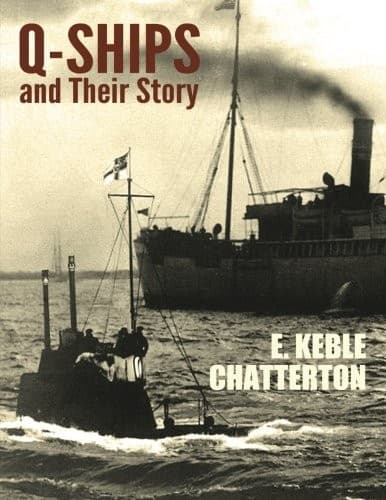
Q-Ships and Their StoryChatterton, E. Keble (Edward Keble)
History
Q-Ships and Their Story
Chatterton, E. Keble (Edward Keble)
Q-ships; World War, 1914-1918 -- Naval operations
With no chart, a doubtful compass, and so few appliances, was there
ever an Atlantic voyage made under more casual circumstances? Bearings
were taken of the Pole Star and Sirius in order to get a check on the
compass, and the ship proceeded roughly on a W.S.W. course. During
the twenty-fifth and twenty-sixth it blew a westerly gale, and the
seas crashed over her without mercy. Owing to the cargo being heavy
and stowed low, the _Dusseldorf_ displayed a quick, lively roll, and
already had broken down twice, when for a third time on the evening of
the twenty-sixth she again stopped. She was now four days out, and the
captain was a little anxious as to his position, but it was impossible
to ascertain it. A cast of the lead was taken and bottom was found at
thirty fathoms. From this it was assumed that they were now somewhere
near the Outer Skerries (East of the Shetlands); and inasmuch as it
was believed there was a German minefield, laid this year, not far
away, anxiety was in nowise lessened. As soon as the repairs had been
effected, course was altered to south-east for 16 miles, then south
for the same distance, and north-west in the hope of making the land.
This was done, but no land appeared, and it was blowing a gale from
the north-west. Whether the ship was now in the North Sea or whether
she had overshot the Shetlands and got the other side of Scotland, who
could say? Neither the error of the compass nor the error of the log
could be known. It was now the twenty-seventh, and they might be north,
south, east, or west of the Shetlands, but, on the whole, Lieutenant
Muhlhauser believed he was in the North Sea, so decided to run south
until well clear of the Moray Firth minefields, and then south-west
until the land was picked up.
The twenty-eighth of February passed without land being sighted,
and there was always the horrible possibility that suddenly the ship
might strike the shore in the darkness. It was a long-drawn-out period
of suspense, aggravated by bad weather and the presence of mines and
submarines. But as spring follows winter and dawn comes after night,
so at length there came relief. At six in the morning of the first of
March a light was picked up on the starboard bow, which, on consulting
a nautical almanack, was identified as the Bell Rock (east of the Tay).
Continuing further south, two trawlers and an armed yacht were sighted
off May Island, so a signal was sent through the yacht to Admiral
Startin at Granton reporting the arrival of a prize captured by _Tay
and Tyne_, and, in due course, having steamed up the Firth of Forth,
_Dusseldorf_ at last came to anchor and reported herself. It had been a
plucky voyage made under the worst conditions, and many an officer has
been decorated for an achievement less than this.
Public-domain text, read in full here on John Shaqi.
Reviews
Reviews
No reviews yet
Be the first to share your thoughts on this work.
Elsewhere in the archive
Join the Discussion
Join the discussion
Sign in to leave a comment or review.
Sign InorCreate an account