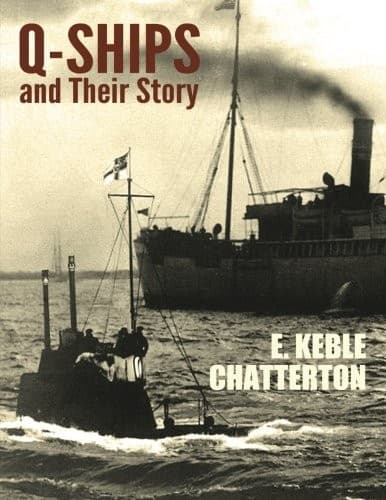
Q-Ships and Their StoryChatterton, E. Keble (Edward Keble)
History
Q-Ships and Their Story
Chatterton, E. Keble (Edward Keble)
Q-ships; World War, 1914-1918 -- Naval operations
As for _Tay and Tyne_, she, too, had passed through a trying period.
After landing the Norwegian pilots and Customs House officials in Sves
Fjord she had steamed out to sea and made bad weather of the gale,
water even pouring into the engine-room; but she had been saved from
foundering by taking shelter in a Norwegian fjord, and next day cruised
about the coast looking for more ore ships, but had no further luck, so
on February 25 shaped a course for Lerwick, where she duly arrived, and
the German prisoners were taken out of the fo’c’sle and handed over to
the naval authorities.
In the following month _Tay and Tyne_, accompanied by another Q-ship
named the _Glendale_, was again off the Norwegian coast on the look-out
for ore ships, just as in Elizabethan days our ancestral seamen were
in a western sea looking out for the Spanish ships with their rich
cargoes. _Glendale_ (alias _Speedwell II._ and Q 23) was a disguised
trawler of 273 tons belonging to Granton, and armed with a couple of
12-pounders, a 6-pounder, and two torpedoes. On the twenty-first of
March, _Glendale_ was off the Oxnaes Lighthouse when she captured the
German S.S. _Valeria_ with 2,200 tons of ore. In vile weather these
three ships then started to cross to Lerwick, but, after they had got
part of the way across, _Valeria’s_ small supply of coal gave out,
so on the twenty-third she had to be abandoned and then sunk by the
shelling from the two Q-ships, the crew having been previously taken
off by boats, while both Q-ships poured oil on to the sea. Although
_Valeria_ never reached a British port this was most useful work; for
not only was the ore prevented from reaching Germany, but they were
deprived of a brand-new 1,000-ton ship. Her captain, who, together with
the rest of the crew, was brought into Lerwick, had only just left the
German Navy, and this was his first trip. Incidents such as these show
what excellent service can be rendered in naval warfare irrespective
of the size of ships and of adverse circumstances, provided only that
the officers have zeal and determination. The risks run by these two
small ships were very great when we consider the manner in which our
Scandinavian convoys had been cut up in spite of destroyer protection.
Conversely, seeing how necessary for the prosecution of the war these
supplies of ore were to Germany, is it not a little surprising that she
did not station a submarine off the Norwegian coast to act as escort,
submerged, and then torpedo the _Tay and Tyne_ as soon as she began to
close the ore ship? One of her smaller submarines could surely have
been spared for such an undertaking, and it would have been, from
their point of view, more than worth while.
Public-domain text, read in full here on John Shaqi.
Reviews
Reviews
No reviews yet
Be the first to share your thoughts on this work.
Elsewhere in the archive
Join the Discussion
Join the discussion
Sign in to leave a comment or review.
Sign InorCreate an account