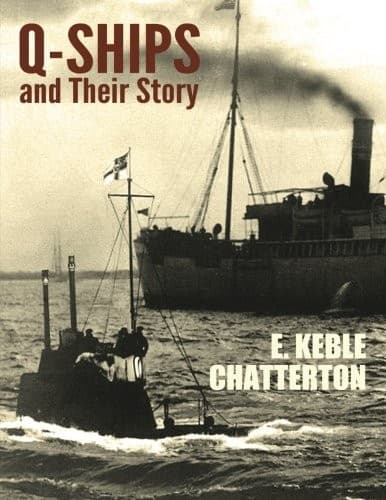
Q-Ships and Their StoryChatterton, E. Keble (Edward Keble)
History
Q-Ships and Their Story
Chatterton, E. Keble (Edward Keble)
Q-ships; World War, 1914-1918 -- Naval operations
And still the Admiralty were not over optimistic as to the capabilities
of the decoy ship, and had to be convinced of the real worth of this
novel idea. However, an incident happened on August 19 which was so
successful and so significant that it entirely changed the official
mind, and all kinds of craft were suggested as suitable decoys. Some
thought that oil-tankers would have made ideal bait: so they would,
but such ships were few in number and too valuable. Others suggested
yachts, and actually these were used for intelligence work in the Bay
of Biscay. Many other schemes, too, were brought forward, but they were
not always practicable, or had to be discarded for particular reasons.
[Illustration:
FIG. 1.—DIAGRAM TO ILLUSTRATE APPROXIMATE MOVEMENTS OF ‘BARALONG’
WHEN SHE SANK U 27 ON AUGUST 19, 1915. THE NUMERALS INDICATE
SIMULTANEOUS POSITIONS OF DECOY AND SUBMARINE.]
[Illustration: Q-SHIP “BARALONG”
Heroine of two famous victories over submarines. Photograph taken in
Malta harbour after the ship had been transferred to the Mediterranean.]
[Illustration: Q-SHIP “REDBREAST”
This vessel was commissioned as a Q-ship at the end of March, 1916, but
six months later had concluded her service in this capacity.
To face p. 22]
In March, 1915, the Admiralty had taken up the S.S. _Baralong_, a
typical ‘three-island’ tramp, as a decoy. For nearly six months she had
been cruising about and had already steamed 12,000 miles, but during
the afternoon of August 19 she was at last to have her chance. This was
an historic day in the submarine campaign, for in that area between the
south-west coast of Ireland and the western end of the English Channel
eight British steamers were sunk, including the 15,801-ton White Star
liner _Arabic_. It is quite certain that there was more than one
submarine operating, and they had reaped a good harvest on the 17th. In
the hope of falling in with one of these U-boats, the _Baralong_ found
herself in Lat. 50.22 N., Long. 8.7 W. (that is, about a hundred miles
south of Queenstown), steering on an easterly course. She was disguised
as a United States cargo ship with American colours painted on boards
on her sides. These boards were made so that they could be hauled in,
and the ensign staff would fall away as soon as the ship should go
into action with the White Ensign hoisted. At three in the afternoon
_Baralong_ sighted a steamer manœuvring rather strangely, and almost
immediately picked up a wireless ‘S.O.S.’ signal from her. _Baralong_
therefore now altered course towards her, and the two ships were soon
steering so that they would presently meet. Then a submarine was
sighted about seven miles off heading towards the steamer, whom she was
shelling. By this time the crew of the steamer, which was the Leyland
liner _Nicosian_, were rowing about in the ship’s boats, and towards
these the _Baralong_ was seen to be approaching, but the submarine U
Public-domain text, read in full here on John Shaqi.
Reviews
Reviews
No reviews yet
Be the first to share your thoughts on this work.
Join the Discussion
Join the discussion
Sign in to leave a comment or review.
Sign InorCreate an account