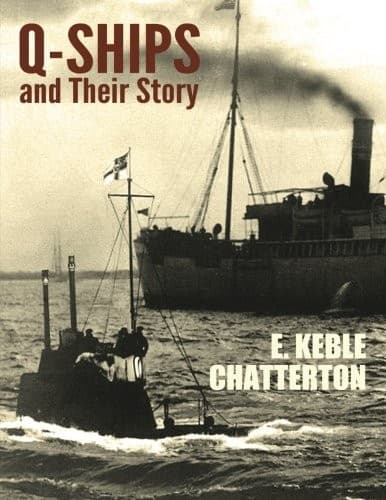
Q-Ships and Their StoryChatterton, E. Keble (Edward Keble)
History
Q-Ships and Their Story
Chatterton, E. Keble (Edward Keble)
Q-ships; World War, 1914-1918 -- Naval operations
This great success in the midst of a terrible tale of shipping losses
finally convinced the authorities of the value of the Q-ship. There
was a great shortage of tonnage at this time, for ships were being
required for carrying mules and munitions from America, munitions to
Russia, and every kind of stores across to our armies. However, it was
decided to take up some more steamers as decoys and fit them out in a
similar manner. Thus the two tramp steamers _Zylpha_ (2,917 tons) and
the _Lodorer_ (3,207 tons) were assigned to Queenstown. The former,
after doing excellent work, was sunk on June 15, 1917; the latter,
commanded by the officer who eventually became Captain Gordon Campbell,
V.C., D.S.O., made history. Under the aliases of _Farnborough_ and Q 5
she became the most famous of all the decoy ships. Tramp steamer though
she may be, she has a career which, for adventurous fights, honourable
wounds, and imperishable glory cannot be approached by any ship in the
world, with the solitary exception, perhaps, of the _Vindictive_, for,
in spite of everything, _Lodorer_ was able at the end of the war to
resume her work in the Merchant Service. In another place we shall soon
see her exploits as a warship.
In addition to these two a few small coasting steamers were taken up
and a couple of transports, and the work of selecting officers of dash
and enterprise had to be undertaken with great secrecy and discretion.
Unquestionably the most suitable type of Q-ship was the tramp, and the
worst was the cross-Channel railway steamer. The first was slow, but
could keep at sea a long time without coaling; the latter was fast,
but wasteful of coal and had limited bunker space. Of these railway
steamers we have already mentioned the G.E.R. Co.’s S.S. _Vienna_
(alias _Antwerp_). Another decoy ship was the L.& S.W.R. Co.’s S.S.
_Princess Ena_, which was built to run between the Channel Islands and
Southampton. She had been commissioned in May, 1915, armed with three
12-pounders, and could steam at 15 knots, but she ceased her decoy work
in the following August. The _Lyons_, already referred to, was really a
salvage steamer, but much resembled a tug, especially when she hoisted
her dummy funnel. She was of 537 tons, could steam at 11 knots, and was
armed with four 12-pounders. But it was the ‘three-island’ tramp type
of the _Baralong_ breed, which was so ordinary and seen at any time in
any sea, that made the ideal Q-ship. She was of 4,192 tons, built in
1901, speed 10 knots, armed with three 12-pounders, and fitted with a
single wireless aerial which could excite no suspicion. So skilfully
was the armament of these ships concealed that they frequently lay in
harbour close to foreign ships without revealing their true nature. I
have myself been all over such a ship, commanded by one of the greatest
Q-ship officers, and entirely failed to find where he mounted his
guns, and yet they were on board ready for immediate use. How much
Public-domain text, read in full here on John Shaqi.
Reviews
Reviews
No reviews yet
Be the first to share your thoughts on this work.
Join the Discussion
Join the discussion
Sign in to leave a comment or review.
Sign InorCreate an account