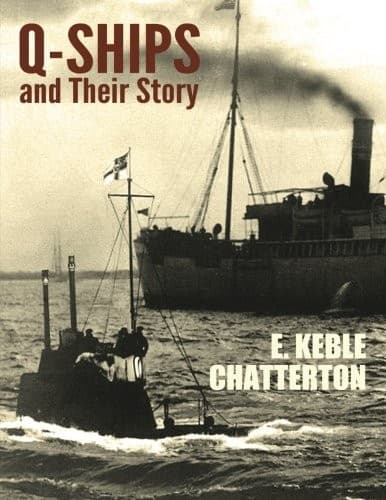
Q-Ships and Their StoryChatterton, E. Keble (Edward Keble)
History
Q-Ships and Their Story
Chatterton, E. Keble (Edward Keble)
Q-ships; World War, 1914-1918 -- Naval operations
more likely would the German submarine, lying lower down to the water,
be deceived! As time went on and these much-feared ‘trap-ships’ were
scrutinized more closely, several minor but fatal characteristics
had to be remembered; for instance, the crew sometimes would be too
smart or the signal-man was too good with his semaphore. But these and
similar points were rectified as soon as they were realized.
CHAPTER III
Q-SHIP ENTERPRISE
Within five weeks of her victorious fight _Baralong_ had done it
again. After the war it was definitely announced in the public Press
that U 27 had been sunk by H.M.S. _Wyandra_ on August 19. Under this
name the ship’s crew were awarded the sum of £185 as prize bounty, and
in the same court _Wyandra_, her commanding officer this time being
Lieut.-Commander A. Wilmot-Smith, R.N., was awarded £170 prize bounty
for sinking U 41 on September 24, 1915. It was an open secret that
_Baralong_ and _Wyandra_ were one and the same ship, so we may as well
get this matter quite clear. Already we have seen the manner in which
this decoy sank U 27, and we shall now be able to note very similar
tactics in almost the same locality attaining a like result under her
new captain.
[Illustration:
FIG. 2.—DIAGRAM TO ILLUSTRATE APPROXIMATE MOVEMENTS OF ‘BARALONG’
WHEN SHE SANK U 41 ON SEPTEMBER 24, 1915. THE LETTERS INDICATE
SIMULTANEOUS POSITIONS OF DECOY AND SUBMARINE.]
U 41 had left Wilhelmshaven on September 12, this being her fourth
trip. She was under the command of Lieut.-Commander Hansen, and on
the 23rd had sunk three British steamers, each of about 4,000 tons,
in a position roughly eighty miles south-east of the Fastnet. The
first of these ships was the _Anglo-Columbian_, which was sunk at 9.45
a.m., followed by the _Chancellor_ at 3 p.m., and the _Hesione_ about
four hours later. The news of the first sinking reached _Baralong_
(henceforth officially known as _Wyandra_) in Falmouth, so this decoy
put to sea, and after rounding the Lizard steered a course that would,
with luck, intercept the submarine if she were operating towards
Ushant, as seemed probable. So the night passed. About 9 o’clock next
morning the British S.S. _Urbino_ (6,651 tons), of the Wilson Line, was
attacked by this U 41 in a position roughly sixty-seven miles S.W. by
W. of the Bishop rock. At 9.45 a.m. up came the _Baralong_, and sighted
the _Urbino_ about eight miles ahead, on fire, stopped, with a heavy
list, and blowing off steam. It was a fine, clear morning; a steady
course was maintained, and the Q-ship made ready for action. Already
the _Urbino’s_ crew had been compelled to take to their boats, and the
submarine, at a range of 200 yards, had put five shells into her.
[Illustration: Q-SHIP “BARALONG”
Showing gun on port side of the poop and disguised crew.]
[Illustration: Q-SHIP “BARALONG”
Showing disguised marines and method of concealing the gun.
To face p. 28]
Public-domain text, read in full here on John Shaqi.
Reviews
Reviews
No reviews yet
Be the first to share your thoughts on this work.
Join the Discussion
Join the discussion
Sign in to leave a comment or review.
Sign InorCreate an account