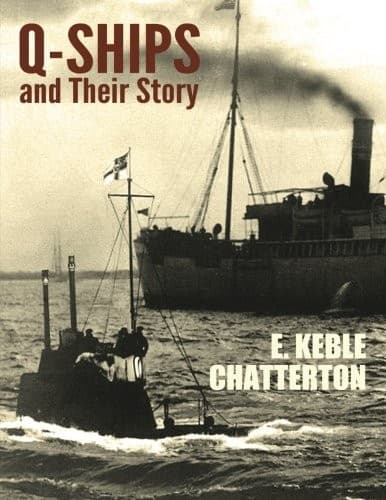
Q-Ships and Their StoryChatterton, E. Keble (Edward Keble)
History
Q-Ships and Their Story
Chatterton, E. Keble (Edward Keble)
Q-ships; World War, 1914-1918 -- Naval operations
On March 1, 1916, the enemy renewed its submarine campaign after lying
dormant since the day when _Baralong_ had sunk her U 41, except for
the Christmas-time temporary outburst. During the first three weeks of
March one, or more, submarine had sunk shipping off the Irish coast
to the extent of three steamers and one sailing craft. On the morning
of March 22, _Farnborough_, who had come from Queenstown, was now
cruising up the west coast of Ireland, the exact position being Lat.
51.54 N., Long. 10.53 W., and the time 6.40 a.m. Steaming along at 8
knots, a submarine awash was suddenly sighted by one of the crew named
Kaye, an A.B. of the Royal Naval Reserve, about five miles away on the
port bow. After a few minutes it dived, and _Farnborough_ coolly took
no notice but kept jogging along the same course. The submarine had
evidently determined to sink the old tramp, for twenty minutes later
she fired a torpedo which passed so close ahead of _Farnborough_ that
bubbles were seen under the forecastle. Still she pretended to take
no notice, and a few minutes later the submarine broke surface about
1,000 yards astern, passing from starboard to port, then, having got on
the Q-ship’s port quarter, fired a shell across the latter’s bows and
partly submerged.
_Farnborough_ now stopped her engines, blew off steam, and the panic
party, consisting of stokers and spare men, were ordered to abandon
ship; so away they rowed under Temporary Engineer Sub-Lieutenant J.
S. Smith, R.N.R. The enemy then came closer until he was but 800
yards off. Not a human being was visible aboard the ‘abandoned’
ship, but everyone was lying concealed in expectant readiness, yet
Lieut.-Commander Campbell was quietly watching every move of the enemy.
A few minutes later the latter, intending to sink the deserted ship,
fired a shell, but this fell 50 yards short. Here was _Farnborough’s_
big opportunity that had been awaited and longed for ever since last
Trafalgar Day; now was the time—or never. Thus the collier tramp
declared herself a man-of-war, armed as she was with five 12-pounders,
two 6-pounders, and one Maxim gun. One of the two ships must certainly
go to her doom, and her fate would be settled in a few terrible
moments: there would be no drawn-out engagement, but just a violent
blow, and then finish. Lieut.-Commander Campbell, in his place of
concealment, knew that his men could be trusted to do the right thing,
knew that they were waiting only for the word from him. True, the
guns’ crews were not the kind of expert men you find in battleship or
cruiser. They had joined the Service after the declaration of war,
but had been trained up splendidly by one of the ship’s officers,
Lieutenant W. Beswick, R.N.R. On them much depended. If they fired too
soon, became excited, made a movement, or bungled their work, they
would give the whole show away, and the sinking ship would not be the
submarine.
Public-domain text, read in full here on John Shaqi.
Reviews
Reviews
No reviews yet
Be the first to share your thoughts on this work.
Join the Discussion
Join the discussion
Sign in to leave a comment or review.
Sign InorCreate an account