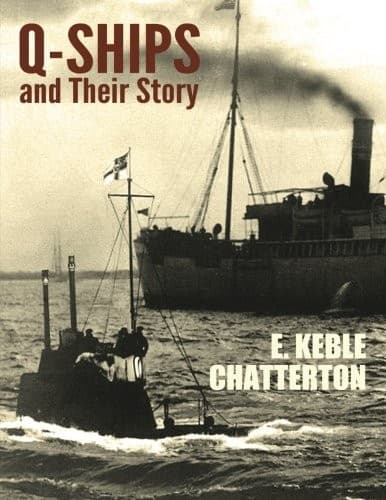
Q-Ships and Their StoryChatterton, E. Keble (Edward Keble)
History
Q-Ships and Their Story
Chatterton, E. Keble (Edward Keble)
Q-ships; World War, 1914-1918 -- Naval operations
‘Open fire!’ came the order as the White Ensign was hoisted, and then
from the three 12-pounders which could bear came a hail of shells,
whilst Maxim and rifle fire also rained down. The light this morning
was bad, but the shooting from these newly trained men was so good
that the submarine was badly holed by the rapid fire; thus, slowly
the enemy began to sink. Observing this, Campbell then endeavoured
to give her the knock-out blow, so steamed full speed over the spot
and dropped a depth charge. This fairly shook the submarine, who next
appeared about ten yards away in an almost perpendicular position, that
portion of the craft from the bows to the conning-tower being out of
the water. A large rent was discerned in her bow; she was certainly
doomed, and one periscope had been hit. Wasting none of the golden
opportunity, _Farnborough_ reopened fire with her after gun, which put
five rounds into the base of the conning-tower at point-blank range,
so that the German sank for the last time. Again _Farnborough_ steamed
over the spot, and let go two more depth charges, and presently up
came a large quantity of oil and bits of wood which covered the sea
for some distance around. So quickly perished U 68, one of the latest
submarines—a 17-knot boat, armed with one 4·1-inch, one 22-pounder,
a machine gun, eleven torpedoes, and with a cruising radius of 11,000
miles.
[Illustration: OFFICERS OF Q-SHIP “FARNBOROUGH”
Captain Campbell with his officers, disguised as a mercantile captain.]
[Illustration: Q-SHIP HEROES
Captain Gordon Campbell, V.C., D.S.O., R.N., and Lieutenant C. G.
Bonner, V.C., D.S.C., of Q-ship “Dunraven,” each wearing the Victoria
Cross, at the King’s Garden Party for V.C.’s. (see Chapter XIV.)
To face p. 42]
This brilliant success had a most cheering effect on all the patrol
vessels working off the Irish coast. With careful reserve the story was
breathed in wardrooms, and it percolated through to other stations,
inspiring even the most bored officer to go forth and do likewise.
This victory had a most important bearing on the future of the Q-ship
service, and officers and men were eager to take on a job which
afforded them so much sport. It meant something more, too. For, junior
though he was, Lieutenant-Commander became Commander Gordon Campbell,
D.S.O.; Lieutenant W. Beswick, R.N.R., who had trained the guns’ crew
so well, and the Engineer-Lieutenant Loveless received each a D.S.C.,
and three of the crew the coveted D.S.M. There followed also the usual
£1,000 in addition to prize bounty. Of the ship’s complement seven
of the officers belonged to the Royal Naval Reserve, and many of the
ratings were either of that service or the Royal Naval Volunteer
Reserve.
Public-domain text, read in full here on John Shaqi.
Reviews
Reviews
No reviews yet
Be the first to share your thoughts on this work.
Join the Discussion
Join the discussion
Sign in to leave a comment or review.
Sign InorCreate an account