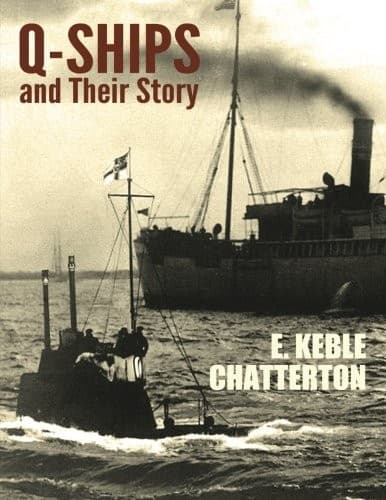
Q-Ships and Their StoryChatterton, E. Keble (Edward Keble)
History
Q-Ships and Their Story
Chatterton, E. Keble (Edward Keble)
Q-ships; World War, 1914-1918 -- Naval operations
of this ship, but it was quite impossible to see where her big 4-inch
and two 12-pounders were located.
That being so, it was not surprising that a submarine never suspected
on September 9, 1916, that this was another ‘trap-ship.’ It was just
before 6.30 in the evening that this steamer was sixty miles south-west
of the Lizard, when a submarine was sighted about 2,000 yards off on
the starboard bow. The enemy had hoisted some flag signals, but they
were too small to be read. It was presumed that it was the usual order
to stop, so the steamer hove-to and the captain called up the stokers
who were off watch to stand by the lifeboats, for all this time the
submarine, who had two guns, was firing at the ship. Having lowered
the starboard lifeboat halfway down to the water, the Q-ship pretended
to try and escape, so went full speed ahead, turned to port, and
brought the enemy right astern. The German maintained a rapid fire,
many shots coming unpleasantly across the bridge, one entering the
forecastle and wounding two men, of whom one afterwards died. Another
shell entered the engineers’ messroom and slightly injured Temporary
Engineer Sub-Lieutenant James Purdy, R.N.R. This same shell also cut
the leads to the wireless room just above.
As several shells fell within a few feet of the ship, Commander Herbert
decided to feign surrender, hoisted the International Code pennant
close up, turned eight points to port, but with the real intention
of firing on the submarine, which had now risen to the surface with
complete buoyancy and presented a good target. But in turning to port,
_Carrigan Head_ was thus brought broadside on to the swell, so that
the ship began to roll heavily and helm had to be altered to get her
head on to the sea. At 6.50 p.m. the enemy was about 1,500 yards away,
and while both lifeboats were being lowered the submarine kept up an
intermittent fire. Three minutes later Commander Herbert decided to
reveal the character of his ship and attack; therefore, going full
speed ahead, he fired seven rounds, one of which seemed to hit. The
submarine was considerably surprised and at once dived, so having
arrived near the spot _Carrigan Head_ dropped depth charges. The enemy
was not sunk, but she did not reappear, such was her fright, until an
hour and a half later when she sank the Norwegian S. S. _Lodsen_ off
the Scillies. The enemy’s behaviour was typical: as soon as he was
attacked he broke off the engagement and took to flight by submerging,
and it was only on the rarest occasions that he was willing to fight,
as were the Q-ships, to a finish.
Public-domain text, read in full here on John Shaqi.
Reviews
Reviews
No reviews yet
Be the first to share your thoughts on this work.
Join the Discussion
Join the discussion
Sign in to leave a comment or review.
Sign InorCreate an account