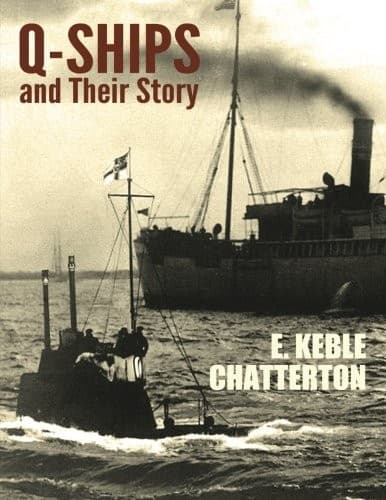
Q-Ships and Their StoryChatterton, E. Keble (Edward Keble)
History
Q-Ships and Their Story
Chatterton, E. Keble (Edward Keble)
Q-ships; World War, 1914-1918 -- Naval operations
One of the greatest enthusiasts of the Q-ship idea was Vice-Admiral
Sir Lewis Bayly, who was in command of the Irish coast. No Q-ship
officer serving under this admiral could ever complain that anything
was left undone by assistance that could have been performed by the
sagacity or advice of this Commander-in-Chief. It was he who made
repeated visits to the Q-ships as they lay in Haulbowline Dockyard,
in order to see that not the smallest important detail for efficiency
was lacking. The positions of the guns, the collapsing of the screens,
the erection of the dummy deckhouses concealing the guns, the comfort
of the personnel—nothing was too trivial for his attention provided
it aimed at the one end of sinking the enemy. As with ships, so with
officers. With his vast knowledge of human nature, and his glance
which penetrated into a man’s very soul, he could size up the right
type of volunteer for decoy work; then, having once selected him and
sent him to sea, he assisted him all the time whenever wireless was
advisable, and on their return to port encouraged, advised, and rested
the captains, while the Haulbowline Dockyard paid every attention to
improving the Q-ship’s fighting power. No keen, capable officer on
this station who did his job ever failed to get his reward; and the
result of all this, and the certain knowledge that if _in extremis_
a Queenstown naval ship would at once be sent to his rescue, created
such a fine spirit that an officer would almost sooner die than
return to port after making a blunder of an engagement. By reason of
this, the Queenstown Q-ships became famous for their high standard
and achievements. In the spring of 1916 the four experienced decoys
_Farnborough_, _Zylpha_, _Vala_, and _Penshurst_, were operating from
that port. They cruised off the south and south-west Irish coasts;
between Milford Haven and the Scillies; off the western approach to
the English Channel; up the Irish Sea as far as the north of Ireland.
In a few weeks four more decoys were added to that station, so that
there were eight of them by July. They cruised along the merchant ship
courses as far out into the Atlantic as 17° W., as far south as the
middle of the Bay of Biscay, as far east as the Isle of Wight, and as
far north as the Hebrides—in other words, just where U-boats were
likely to attack. One of these eight was the S.S. _Carrigan Head_,
which was commanded by Lieut.-Commander Godfrey Herbert, D.S.O., R.N.,
late in command of the _Antwerp_. _Carrigan Head_ was a fine ship of
4,201 tons, and, in order to make her practically unsinkable, she was
sent to Portsmouth, where she was filled with empty casks and timber.
As may be expected from her commander, this was a very efficient ship.
Below, the timber had been stowed in the holds with great cleverness
so that it would have been a considerable time before she could ever
founder. I well remember on one occasion wandering all over the decks
Public-domain text, read in full here on John Shaqi.
Reviews
Reviews
No reviews yet
Be the first to share your thoughts on this work.
Join the Discussion
Join the discussion
Sign in to leave a comment or review.
Sign InorCreate an account