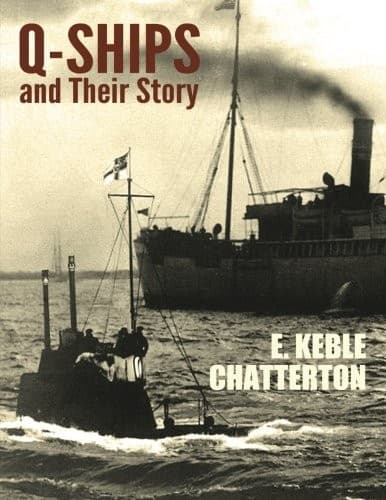
Q-Ships and Their StoryChatterton, E. Keble (Edward Keble)
History
Q-Ships and Their Story
Chatterton, E. Keble (Edward Keble)
Q-ships; World War, 1914-1918 -- Naval operations
One of these smacks was the _Telesia_, armed only with a 3-pounder,
and commanded by Skipper W. S. Wharton, who did extraordinarily well
in this dangerous service. On March 23, 1916, he was trawling roughly
thirty-five miles S.E. of Lowestoft, when about midday he sighted a
submarine three miles off, steering to the north-east. At 1.30 p.m.
the German, who was evidently one of the cautious type, and having
a careful scrutiny before attacking, approached within 50 yards of
the _Telesia’s_ starboard bow, and submerged with her periscope just
showing. She came back an hour later to have another look, and again
disappeared until 4.30 p.m., when she approached from the north-east.
Having got about 300 yards away she attacked, but she had not the
courage to fight on the surface a little sailing craft built of wood.
Instead, she remained submerged and fired a torpedo. Had that hit,
_Telesia_ and her men would have been blown to pieces; but it just
missed the smack’s bows by four feet. Skipper Wharton at once brought
his gun into action, and fired fifteen rounds at the periscope, which
was the only part of her that could be seen, and an almost impossible
target. The enemy disappeared, but arrived back in half an hour,
and this time the periscope showed on the starboard quarter, coming
straight for the smack, and rising out of the water at the same time.
Again she fired a torpedo, and it seemed certain to hit, but happily
it passed 40 feet astern. At a range of only 75 yards the smack now
fired a couple of shots as the enemy showed her deck. The first shot
seemed to hit the conning-tower, and then the fore part of the hull was
observed coming out of the water. The second shot struck between the
conning-tower and the hatch, whereupon the enemy went down by the bows,
showing her propeller. She was a big craft, judging by the size of
her conning-tower, and certainly larger than those which had recently
been sinking Lowestoft smacks. Skipper Wharton, whilst fishing, had
himself been chased, so he was fairly familiar with their appearance.
Whether the enemy was actually sunk is a matter of doubt. Perhaps she
was not destroyed, although UB 13 was lost this month; how and where
are unknown. One thing is certain, however, that the little _Telesia_
caused her to break off the engagement and disappear. The smack could
do no more, for the wind had now died right away, and this fact
demonstrated the importance of these decoy smacks being fitted with
motors, so that the craft would be able to manœuvre in the absence of
wind; and this improved equipment was now in certain cases adopted.
Skipper Wharton well deserved his D.S.C. for this incident, and two of
the ship’s company also received the D.S.M. The whole crew numbered
eight, consisting of Skipper Wharton, a naval chief petty officer, a
leading seaman, a marine, an A.B., and three fishermen.
Public-domain text, read in full here on John Shaqi.
Reviews
Reviews
No reviews yet
Be the first to share your thoughts on this work.
Join the Discussion
Join the discussion
Sign in to leave a comment or review.
Sign InorCreate an account