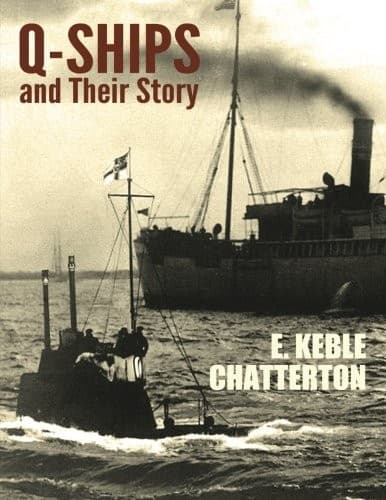
Q-Ships and Their StoryChatterton, E. Keble (Edward Keble)
History
Q-Ships and Their Story
Chatterton, E. Keble (Edward Keble)
Q-ships; World War, 1914-1918 -- Naval operations
On the following April 23 _Telesia_—this time under the name of
_Hobbyhawk_ and under the command of Lieutenant H. W. Harvey,
R.N.V.R.—together with a similar smack named the _Cheero_, commanded
by Lieutenant W. F. Scott, R.N.R., put to sea from Lowestoft. They
had recently been fitted with specially designed nets, to which were
attached mines. It had been found that with 600 yards of these nets
towing astern the smack could still sail ahead at a speed of 3 knots.
A bridle made out of a trawler’s warp was stopped down the towing wire
and from forward of the smack, so that she would look exactly like
a genuine smack when fishing with the ordinary trawl. All that was
required was that the submarine should foul these nets astern, when, if
everything worked as it should, destruction to the enemy would follow.
At 5.45 that afternoon, when 10 miles N.E. of the Smith’s Knoll
Pillar Buoy, the nets were shot and the batteries connected up to
the net-mines. The wind was light, so _Cheero_, towing away to the
south-east, was going ahead very slowly. Each of these two smacks was
fitted with a hydrophone by means of which the beat of a vessel’s
engines could be heard, the noise of a submarine’s being very different
from that of reciprocating engines in a steamer. About 7 p.m. _Cheero_
distinctly heard on her instrument the steady, quick, buzzing,
unmistakable noise of a submarine, and the noise gradually increased.
About three-quarters of an hour later the wire leading to the nets
suddenly became tight and stretched along the smack’s rail. The strain
eased up a little, became tight again, then an explosion followed in
the nets, and the sounds of the submarine’s engines were never heard
again. The sea was blown by the explosion 20 feet high, and as the
water was settling down another upheaval took place, followed by
oil. The crew remained at their stations for a few minutes awaiting
further developments, and then were ordered to haul the nets, but a
great strain was now felt, so that instead of two men it required
six. As the second net was coming in, the whole fleet of nets took a
sharp angle down, and a small piece of steel was brought on board.
Other pieces of steel came adrift and fell into the sea. As the third
net was being hauled in, the whole of the nets suddenly became free
and were got in quite easily, whilst the crew remarked on the strong
smell of oil. It was found that one mine had exploded, and when the
nets were eventually further examined ashore in Lowestoft there could
be no doubt but that a submarine had been blown up, and more pieces
of steel, some of considerable size, dropped out. Thus UC 3, with all
hands, was destroyed. She was one of the small mine-layers which used
to come across from Zeebrugge fouling the shipping tracks along the
East Anglian coast with her deadly cargoes, and causing the destruction
of merchant shipping, Allied and neutral alike. On May 18 of the same
Public-domain text, read in full here on John Shaqi.
Reviews
Reviews
No reviews yet
Be the first to share your thoughts on this work.
Join the Discussion
Join the discussion
Sign in to leave a comment or review.
Sign InorCreate an account