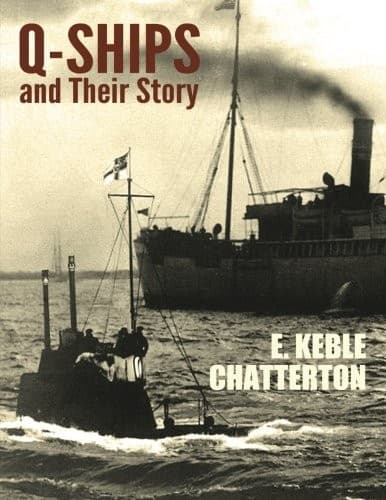
Q-Ships and Their StoryChatterton, E. Keble (Edward Keble)
History
Q-Ships and Their Story
Chatterton, E. Keble (Edward Keble)
Q-ships; World War, 1914-1918 -- Naval operations
year _Hobbyhawk_ (_Telesia_) and a similar smack, the _Revenge_ (alias
_Fame_), had a stiff encounter with a submarine in about the same
place, but there is reason to suppose that in this case the enemy was
not sunk.
This idea of commissioning sailing smacks as Q-ships now began to be
adopted in other areas. Obviously only that kind of fishing craft could
be employed which ordinarily were wont to fish those particular waters;
otherwise the submarine would at once have become suspicious. Thus, at
the end of May, a couple of Brixham smacks, which usually fished out
of Milford, were fitted out at Falmouth, armed each with a 12-pounder,
and then sent round to operate in the Milford district. These were the
_Kermes_ and _Strumbles_ respectively. They were manned by a specially
selected crew, and the two commanding officers were Lieutenant E. L.
Hughes, R.N.R., and Sub-Lieutenant J. Hayes, R.N.R. But although they
were given a good trial, these craft were not suitable as soon as the
autumn bad weather came on. Their freeboard was too low, they heeled
over too much in the strong prevailing winds, so that it was difficult
to get the gun to bear either to windward or leeward; and, except when
on the top of a sea, their range of vision was limited, so before
November was out these ships ceased to be men-of-war and were returned
to their owners.
Along the Yorkshire coast is found a type of open boat which is never
seen farther north than Northumberland and never farther south than
Lincolnshire. This is the cobble, a peculiar and rather tricky kind
of craft used by the fishermen of Whitby, Scarborough, Bridlington,
Filey, and elsewhere. They carry one lug-sail and can be rowed, a
single thole-pin taking the place of a rowlock. The smaller type of
cobble measures 28 feet long by 2-1/4 feet deep, but the larger type,
capable of carrying nine tons, is just under 34 feet long by 4-3/4 feet
deep. Here, then, was a boat which, with her shallow draught, could
with safety sail about in the numerous minefields off the Yorkshire
coast. No submarine would ever suspect these as being anything but
fishermen trying to snatch a living. In the early summer of 1916 two of
these boats, the _Thalia_ and _Blessing_, were commissioned. They were
sailing cobbles fitted with auxiliary motors, and were sent to work
south-east of the Humber in the Silver Pit area. Here they pretended
to fish, towing 300 yards of mine-nets, 30 feet deep, in the hope that,
as had happened off Lowestoft, the submarine would come along and be
blown up. However, they had no luck, and after a few months’ service
these boats also were returned to their owners. But in spite of this,
Q-sailing-ships were still being taken up, the difficulty being to
select the right type. Even in the Mediterranean the idea was employed.
Enemy submarines had been destroying a number of sailing vessels, so
the Admiralty purchased one local craft, gave her a small auxiliary
Public-domain text, read in full here on John Shaqi.
Reviews
Reviews
No reviews yet
Be the first to share your thoughts on this work.
Join the Discussion
Join the discussion
Sign in to leave a comment or review.
Sign InorCreate an account